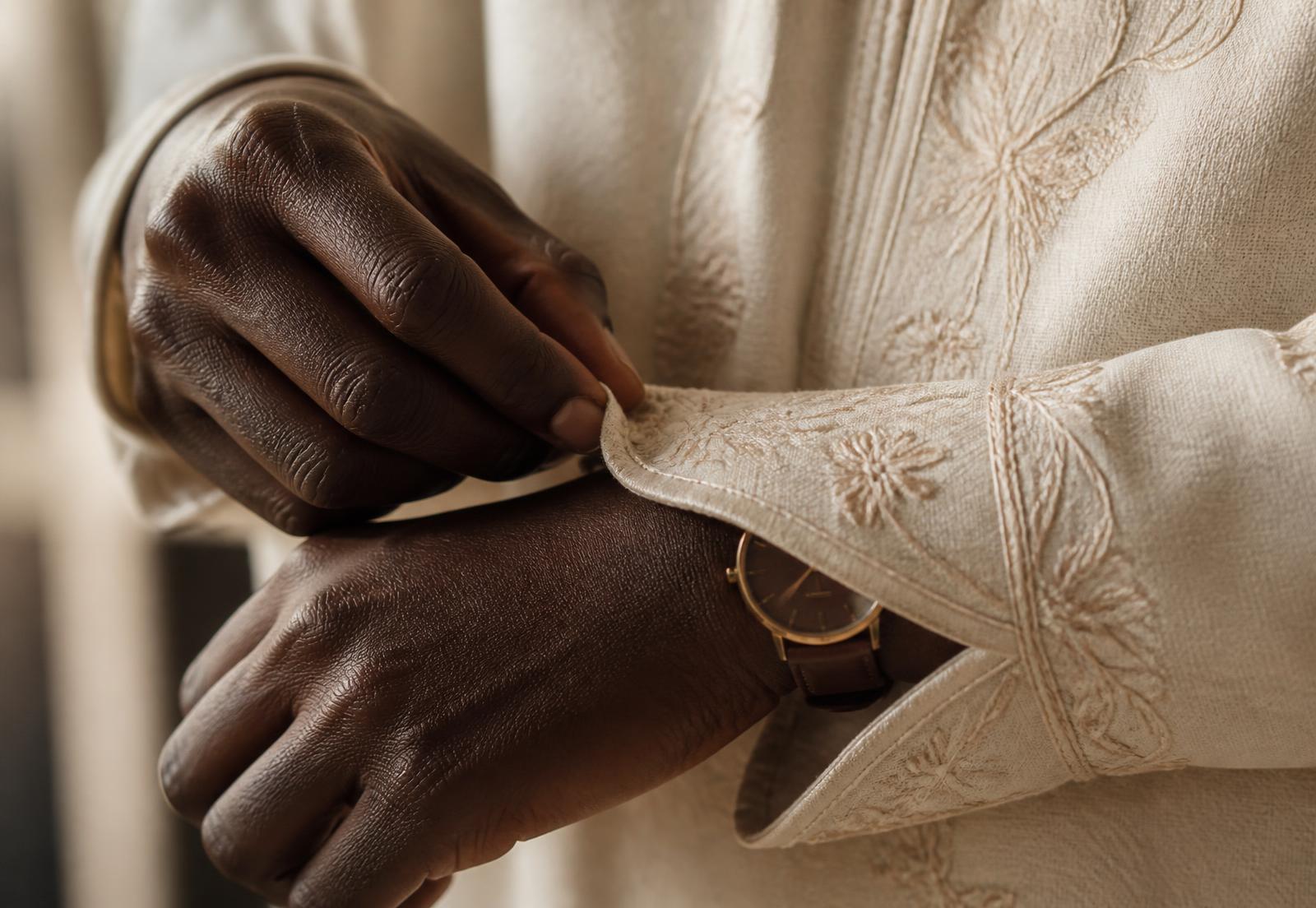
For years I walked into tailors and said some version of "something nice for a wedding". I got back exactly what that sentence deserved.
A brief is not a demand and it does not make you difficult. It is the thing that lets a good tailor do their job well, and it is how you find out early whether the person in front of you is one. Figures below are indicative UK market ranges for 2026.
01
The first message, in full
Send all of this at once. It saves a week of exchanges and it signals seriousness.
- The date and the room. "Wedding reception, Saturday 12 September, hotel ballroom in central London, six o'clock start."
- The register. Agbada, kaftan, senator set, dinner jacket. If you are unsure, say what everyone else will be wearing.
- Whether you are in aso ebi and when the cloth will reach you.
- Your budget as a number. "Around £700 for the outfit." A range gets you quoted at the top of it.
- Three reference photographs — and one of something you do not want, which is more useful than the three.
- What usually fits you badly. "Shoulders are always too wide, sleeves always too long." This is the most valuable sentence in the message.
- Your height and weight, and whether either is likely to move before the date.
02
Eighteen questions before you pay
- 01
How many fittings are included in the price?
Two is right for a first commission. One means you are absorbing the risk.
- 02
Who does the making, and who does the embroidery?
Often two different people in two different places. That is fine — knowing it lets you ask about the second timeline.
- 03
What is the cloth, and what weight in grams per metre?
The single question that most separates a house that knows its material from one that does not.
- 04
What lining will you use?
Ask for cupro or cotton voile. Acetate is the default and the reason a good outfit stops being comfortable at hour six.
- 05
Can I see finished work on a build like mine?
Every tailor has a flattering portfolio. Ask specifically for your frame.
- 06
What is the realistic completion date, not the best case?
Then add two weeks yourself for anything embroidered.
- 07
What happens if it is not right at the second fitting?
You want to hear a process, not reassurance.
- 08
Are alterations after collection included, and for how long?
Thirty days is a good answer. Nothing is a warning.
- 09
How much cloth are you buying, and can I keep the offcuts?
Half a metre in your wardrobe has saved outfits of mine twice.
- 10
What is the deposit, and is it refundable before cutting?
Fifty per cent at commission is standard. Get the cutting date in writing.
- 11
Do you charge separately for the cap, and will it be fitted?
An unfitted cap undoes the whole outfit in photographs.
- 12
Will the trouser be finished with a hem or left long?
Confirm it is hemmed with your actual shoes present.
- 13
Can the shoulder be softer or more structured?
The one detail that most changes how a garment reads on you.
- 14
How wide will the sleeve fall, in centimetres?
For agbada, the difference between magnificent and comical is measurable.
- 15
Will the embroidery be hand-done or machine?
Both are legitimate. The price difference is large and should be stated.
- 16
Can you work with cloth I supply, and does that change the guarantee?
Most will. Some will not stand behind cloth they did not source.
- 17
If I gain or lose weight before the date, what is adjustable?
Ask for extra inlay at the waist and seat at the cutting stage.
- 18
Have you made for an event in this kind of room before?
A hall in February and a marquee in July are two different commissions.
You will not ask all eighteen. Ask the first eight and you will already know more than I did for a decade.
03
What a proper measurement looks like
A full set takes fifteen to twenty minutes and involves being turned around. If it takes four minutes and three numbers, you are being sized, not measured.
Expect: neck, chest, waist, seat, shoulder width, back length, sleeve length, bicep, wrist, outseam, inseam, thigh, knee, hem opening — and for native attire, the full length from shoulder to hem and the sleeve fall. Ask for a copy of the sheet in centimetres. It is yours, and it makes every future commission faster.
Ask what they are adding for ease, and where. A tailor who says "four centimetres at the chest, two at the waist" is thinking. A tailor who says "don't worry" is guessing.
04
The fitting checklist
- 01Sit down properly, then sit back in the chair. Most fitting problems only appear seated.
- 02Raise both arms above your head. The shoulder should move with you, not lift off your neck.
- 03Do up every button and fastening, including the ones you never intend to use.
- 04Put your hands in the pockets, then take them out and check the line has returned.
- 05Look at the back of your neck in a second mirror — collar gap is the hardest thing to fix later.
- 06Wear the actual shoes. Hem and break cannot be judged in trainers.
- 07Walk ten paces and watch the hem. On an agbada or kaftan it should hang straight, not swing forward.
- 08Photograph yourself in it, front and back, with flash. Then look at the photograph, not the mirror.
05
How to ask for a change
Describe the effect you want, not the alteration you think achieves it. Tailors solve problems; they resent instructions that fight their own solution.
- Instead of "take in the sides" — "it feels loose across my back when I reach forward."
- Instead of "make it shorter" — "I want the hem to sit here," and put a finger on it.
- Instead of "the shoulders are wrong" — "the shoulder seam sits past the edge of my own shoulder."
- Instead of "I don't like it" — "which of these two things is easier to change?"
And say it at the first fitting, not the second. Once embroidery is on the cloth, most changes stop being possible.
06
Deposits, balances and what happens if it is wrong
Fifty per cent at commission, balance on collection, is the normal UK arrangement for made-to-measure and native attire. Cloth is usually charged in full up front because it is cut for you.
Get four things in writing, even if only in a message thread: the total, what it includes, the completion date, and the number of fittings. That thread is the whole of your protection and it costs nothing.
Indicative alteration costs if you are working with something bought off the peg: sleeve length £20–£45, waist £25–£60, trouser hem £15–£30, shoulders £60–£150 and often not worth it. Shoulders are why buying for the chest matters.
07
Red flags I now walk away from
- No fitting offered at all for a first commission.
- Refusal to name the cloth or its weight.
- Full payment demanded before cutting.
- A portfolio entirely of photographs taken from behind or in shadow.
- Vagueness about who does the embroidery and where.
- Irritation at questions. A tailor who has an opinion about your brief is good; a tailor annoyed by it is not.
- A completion date the same week as your event.
The directory exists because of this list. It is deliberately small — only hands I would send a friend to.
What to do next
Write your brief down before the appointment. Bring the cloth, the date and two photographs.
Tell me the occasion, the date and your budget bracket. Within 24 hours you get back: two or three houses I would actually approach and why those and not others, the alterations to insist on for your build, a realistic timeline for your date, and a short written brief you can hand to the tailor at the first fitting.
- No fee, no commission, nothing sold here.
- If nobody I trust fits your date or budget, I say so.
- Read by me, answered by me.
Read next