The first black tie invitation I took seriously was a charity gala at a hotel on Park Lane. I hired a black dinner suit, wore the hired shirt and the pre-tied bow tie, and looked exactly like a man wearing somebody else's clothes. Nobody said anything. The photographs said everything.
What follows is what I have worn and had made since. Prices are indicative UK market ranges for 2026 rather than quotes — where a number is what I personally paid, I say so.
01
What the invitation is actually asking
Black tie is not "smart". It is a specific evening code, and in Britain it carries an assumption most invitations never spell out: after six, indoors, dark, and matte.
It also carries an allowance that almost nobody tells Nigerian men about. National dress has always been an accepted alternative to a dinner jacket. A well-cut agbada or embellished kaftan in black or midnight is not a compromise at a black tie event — it is the code, honoured in another tradition.
What the code genuinely refuses: a business suit, a coloured shirt, a long tie, and brown shoes. Those are the four things that get noticed.
02
The ladder, and where black tie sits
Black tie. Dinner jacket or formal national dress. Bow tie. Evening shoes. The default for galas, awards, hotel balls and formal wedding receptions.
Black tie optional. A dinner jacket is welcome, a dark suit will pass. Wear the dinner jacket — the hosts wrote "optional" to be kind, not to lower the room.
Creative black tie. The code, with one deliberate liberty: a velvet jacket, an embellished kaftan, tonal beading. One liberty, not three.
White tie. A different garment entirely — tailcoat, wing collar, white waistcoat. Rare in Britain now, and never something to improvise.
Lounge suit / formal. Below black tie. A dinner jacket here reads as showing up to overshoot.
03
Two correct routes: dinner jacket or native
There is no third route. Every mistake I have seen at a black tie event in Britain is a hybrid — a dinner jacket with a native shirt, an agbada with a bow tie, a senator set with satin lapels stitched on.
Choose the dinner jacket when the event is institutional: a City dinner, an awards night, a partner's work gala, a British wedding. You want to be legible before you are memorable.
Choose native when the room is ours, or mixed and celebratory: a Nigerian gala, a diaspora awards night, a wedding reception where half the room is in aso ebi. Here the dinner jacket is the safe choice and the agbada is the correct one.
Whichever you choose, commit to it completely. The code punishes hedging more than it punishes ambition.
04
The dinner jacket, detail by detail
Colour. Midnight blue over black. Under the warm, low light of British ballrooms, midnight reads deeper and blacker than black, which goes flat and slightly green.
Lapel. Peak or shawl, faced in grosgrain or satin. A notch lapel with a satin edge is a business jacket in costume.
Buttons. One, always. Two buttons on a dinner jacket is the most common tell in the room.
Vents. None, traditionally. Side vents are acceptable and more comfortable if you will be sitting for three courses.
Trouser. Plain front, no belt loops, single satin or braid stripe down the outside seam. Held with side adjusters or braces — never a belt.
Shirt. White, marcella (pique) bib or fine pleats, turndown collar. Double cuffs with simple links. Skip the wing collar unless you are in white tie.
Bow tie. Self-tie, black silk, matching your lapel facing. The slight imperfection of a hand-tied bow is the entire point of it.
Waist covering. Cummerbund or a low-cut evening waistcoat. Something should cover the waistband; nothing should be visible between the bow tie and the button.
Shoes. Black oxfords, patent or highly polished, or velvet evening slippers. Black silk socks, long enough that no leg shows when you cross them.
Nothing else. One watch, thin, or none at all. No pocket square in a colour, no lapel pin, no chain.
05
The native route, done properly
This is where I have had the most success, and it takes more discipline rather than less.
Colour. Black or midnight, one tone through the whole outfit. Colour is what pulls a native look down from black tie into owambe register — and both are good, but they are not the same evening.
Embellishment. Tonal only. Black beading on black cloth, or a raised black-on-black embroidery. Gold thread across the chest is magnificent and it is not black tie.
Cut. Evening formality lives in the line. A real shoulder, a hem that hangs straight, a trouser that finishes cleanly on the shoe. An unaltered agbada will always read as casual regardless of the cloth.
Cloth. Barathea, fine wool-silk, or a matte heavy silk. Nothing with sheen — the flash finds it.
Shoes. Evening shoes, not the sandals you would wear to an owambe. A polished slip-on, a gold-bit loafer, or velvet.
Cap. A fitted black fila, or nothing. I often go without at black tie, because a cap raises the ceremony of the look and sometimes the room does not warrant it.
06
Cloth, and the rooms it has to survive
British black tie happens in two kinds of room: a cold hotel ballroom in November and an overheated one with four hundred people in it. Usually the same room, ninety minutes apart.
Barathea wool. The traditional evening cloth and still the right answer. Matte, dense, holds a crease, photographs as true black. Around 300g works year-round in Britain.
Wool-mohair. Slightly crisper, lighter, with a dry lustre. Better for a summer ball or a room you know runs hot.
Velvet. For the jacket only, and only in a creative black tie room. Midnight or deep forest. Warm to wear — do not choose it for a July event.
Polyester-blend evening cloth. What most hire and fast-fashion dinner suits are made from. It shines under flash and it does not breathe. If this is the tier you are in, the alterations matter twice as much.
One practical note: British formal events run long and start late. If you are travelling in, take the jacket on a hanger and put it on at the venue.
07
Four routes, by budget
Indicative UK ranges for 2026, alterations included. For context: high-street dinner suits sit around £300 to £600, established made-to-measure programmes around £2,000 to £3,200, and Savile Row bespoke from roughly £5,500 upwards.
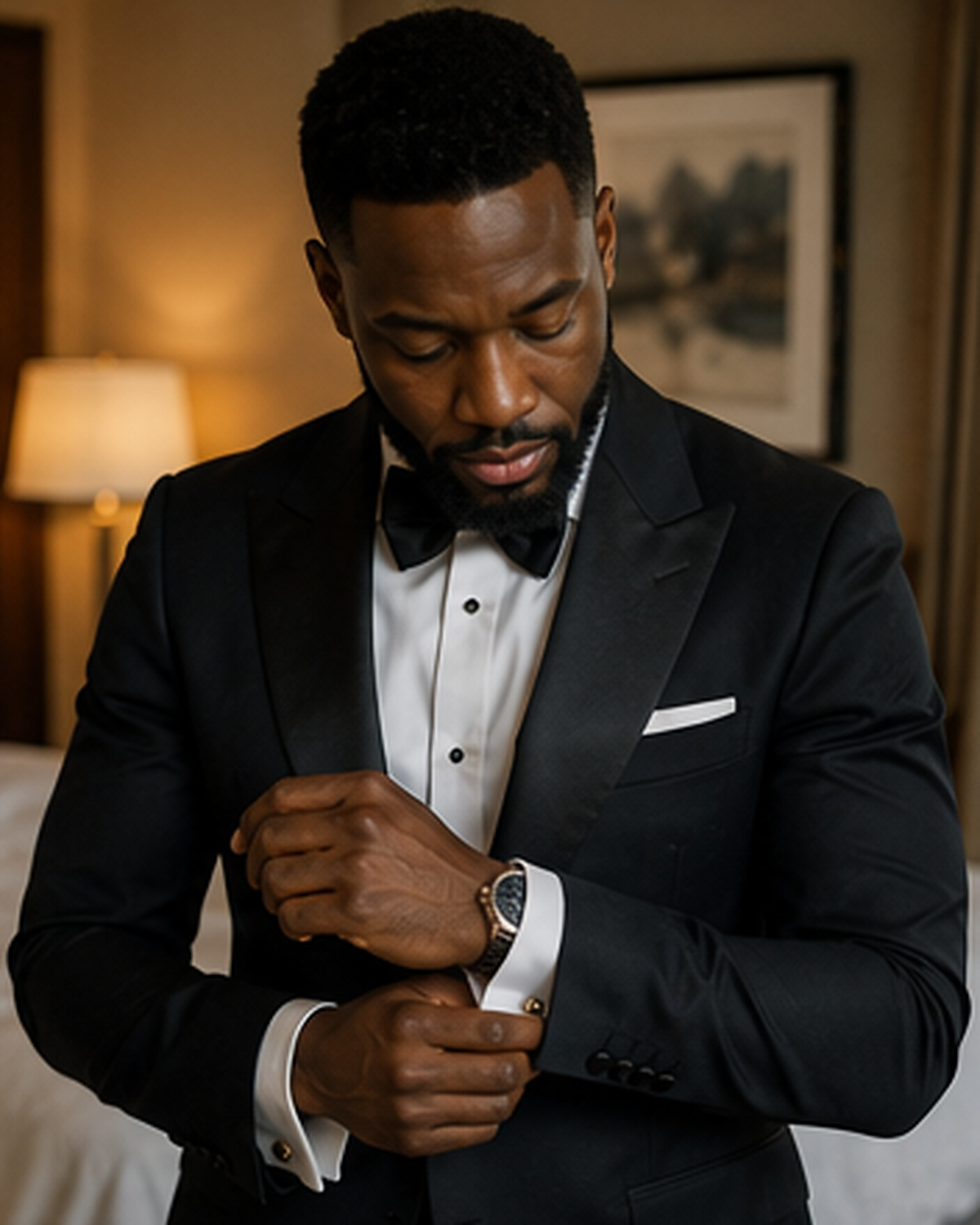
£90–£200 — hire, done without embarrassment
- Hire the jacket and trouser only. Buy your own shirt, bow tie and shoes — the hired ones are what give hire away.
- Collect three days early and take it to a tailor for sleeve length and trouser hem.
- Insist on a peak lapel or shawl collar. Refuse a notch lapel with a satin edge.
Right for a one-off. I have done this and nobody knew, because the shirt and shoes were mine.
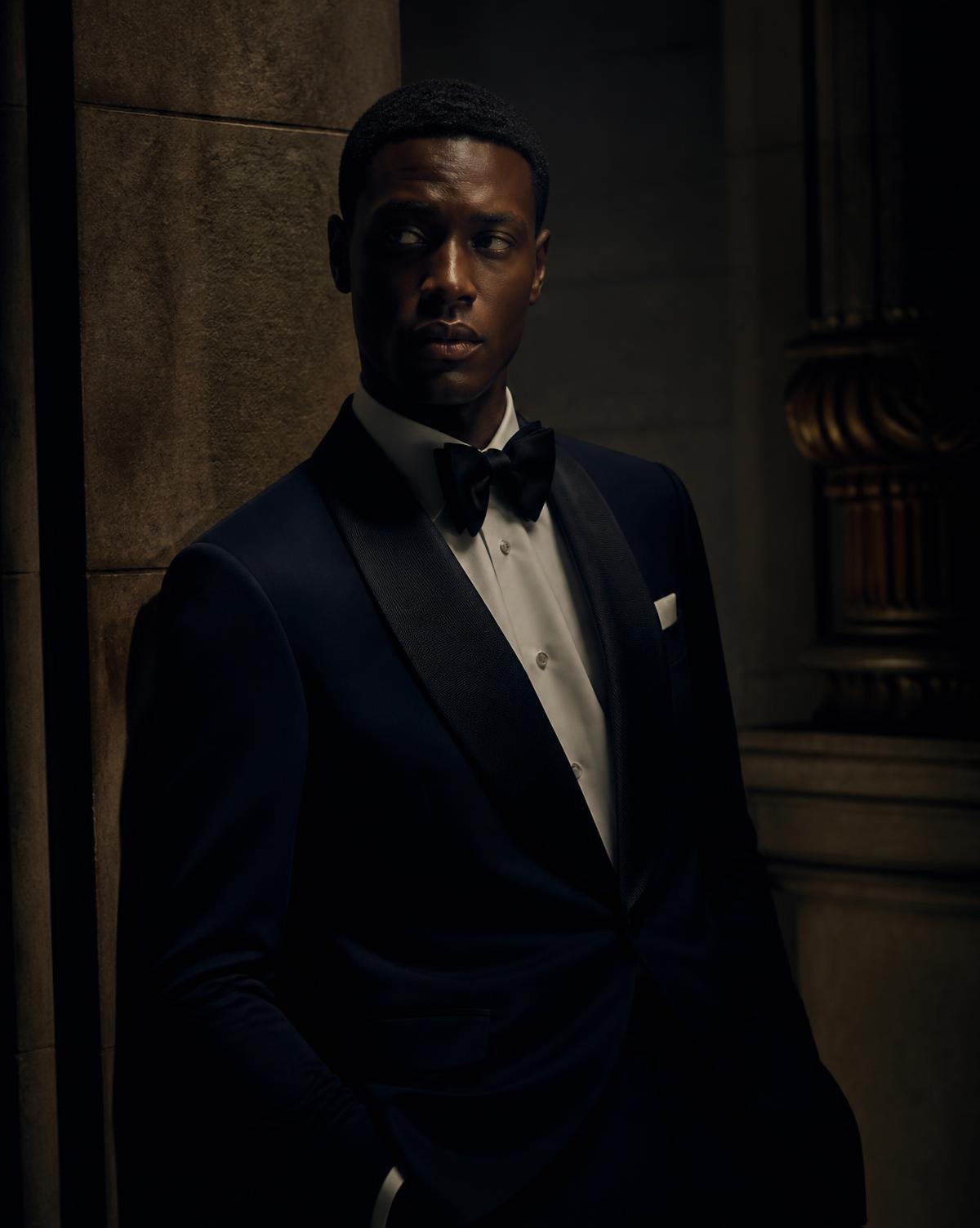
£300–£600 — high street, corrected
- A midnight blue dinner suit in wool, shawl or peak lapel, plain-front trouser with a satin side stripe.
- £80–£150 of alterations: sleeve, waist, trouser taper, jacket length. Non-negotiable.
- Marcella or fine pleated shirt, self-tie bow tie, plain black oxfords or velvet slippers.
Where most men should start. A corrected £400 dinner suit beats an unaltered £1,200 one in every photograph.
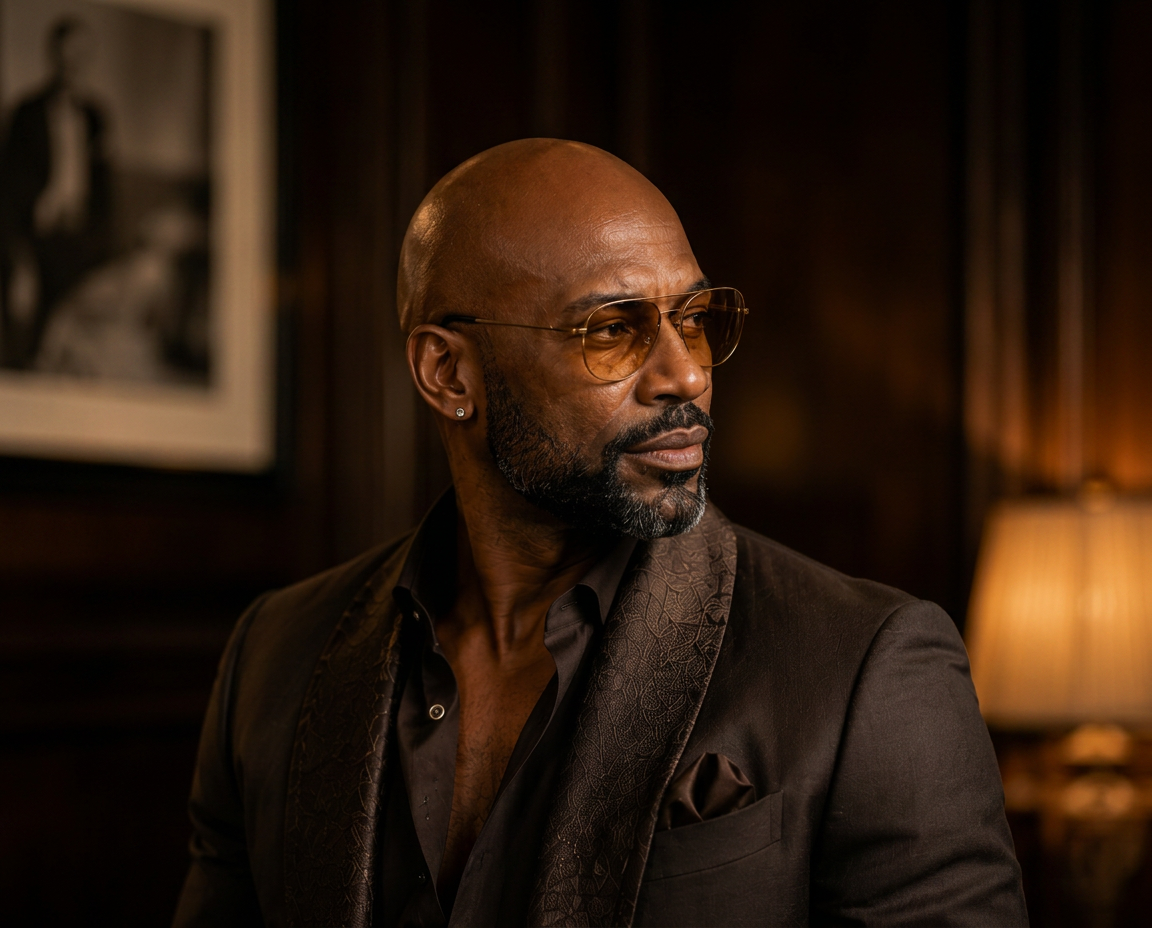
£900–£1,500 — entry made-to-measure
- Made-to-measure in midnight barathea or a fine wool-mohair, cut to your shoulder, one button, no vents.
- Two fittings. Ask for a slightly longer jacket than the shop default — evening tailoring wants coverage.
- This is the tier where the trouser finally fits, which is the difference nobody can name but everyone sees.
If you go to two or three black tie events a year, this pays for itself inside eighteen months.
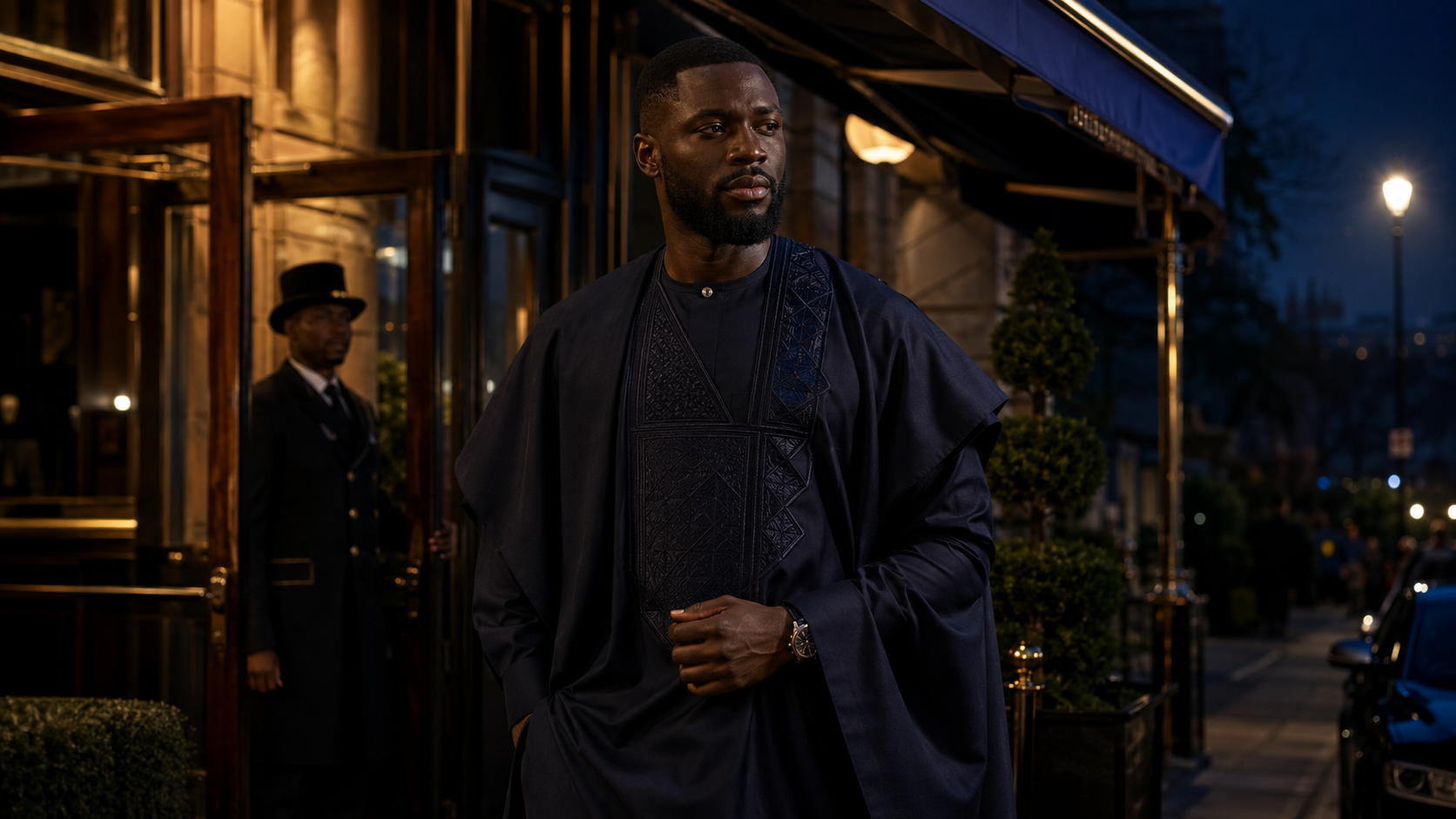
£1,200–£2,500 — the native route
- An agbada, kaftan or embellished senator set in black or midnight, tonal beading, no colour contrast.
- Evening shoes, not day shoes: a polished slip-on, a gold-bit loafer, or velvet.
- Cap fitted at the tailor, or no cap at all. Half-measures show.
My favourite way to do black tie in Britain. Formal on its own terms, and the only look in the room nobody else is wearing.
08
What to change for your build
Evening cloth is unforgiving because it is plain — there is no pattern to hide a bad line. The longer version of this, with looks attached, sits in Build Filter™.
- Broad
- Peak lapel, one button, soft shoulder, no vents. Midnight over black. Skip the waistcoat — a cummerbund sits flatter.
- Tall
- Longer jacket than the default, wider lapel to match your scale, and a proper trouser rise. A cummerbund breaks the vertical usefully.
- Athletic
- Buy for the chest and pay to bring the waist and sleeve in. Avoid stretch evening cloth — it shines under flash.
- Slim
- Shawl collar and a little shoulder structure. Barathea rather than mohair; the extra body helps.
- Shorter
- Shorter jacket, higher trouser rise, no break. One tone head to toe, and never a contrasting waistcoat.
- Fuller
- Single-breasted, one button, matte barathea, cummerbund rather than waistcoat, worn slightly longer.
09
Hire, buy, or have made
Hire if this is a one-off and the date is close. Hire the jacket and trouser, own the shirt, bow tie and shoes, and take the hired pieces to a tailor before the day. Hire looks like hire mainly because of the accessories and the sleeve length.
Buy and alter if you will wear it once a year. A midnight dinner suit is the least fashion-dependent garment you can own — a good one lasts a decade.
Have made if you go to two or more events a year, if you are broad, tall or short enough that off-the-peg never works, or if you are taking the native route. Agbada and embellished kaftans should always be made; the volume is the point and off-the-peg volume is cut straight through the waist.
What I would not do: buy an unaltered dinner suit online in the week of the event. I have done it. The trouser hem told everybody.
10
The timeline, working backwards
- Ten weeks out: decide the route — dinner jacket or native. Everything else follows from that one decision.
- Eight weeks: commission made-to-measure, or order native from Lagos and add four weeks.
- Five weeks: buy the shirt, bow tie and shoes. Start wearing the shoes indoors now.
- Three weeks: first fitting, or book alterations on an off-the-peg suit.
- One week: second fitting. Learn to tie the bow tie this week, not on the night.
- The night before: full outfit on, jacket buttoned, photographed under a warm lamp. Black and midnight look completely different in that light than in daylight.
11
Mistakes I have made in a dinner jacket
- 01A pre-tied bow tie, for years.
- 02Black instead of midnight in warm indoor light.
- 03A notch lapel with a satin edge, bought because it was cheaper.
- 04Two buttons on a dinner jacket.
- 05A belt through a dinner trouser.
- 06Nothing covering the waistband, so the shirt bloused all night.
- 07Brown shoes, once, and I knew before I left the house.
- 08Hired shirt, hired shoes, hired everything.
- 09Gold embroidery on a black kaftan to a formal gala — beautiful, and the wrong code.
- 10Short socks, crossed legs, three inches of leg in the photograph.
12
Who to contact, and what to say
For a dinner jacket, you want a tailor who cuts evening cloth regularly — it is plainer and less forgiving than a day suit. For the native route, you want a house that can hold a black-on-black line without reaching for gold.
What to say when you make contact: the date, the event and the room, which route you have chosen, your budget as a number, and that you want it matte. Ask what they would change about your brief. A tailor with an opinion is a tailor worth paying.
What to do next
Decide between midnight barathea and something with more character. Then book the fitting early.
Tell me the occasion, the date and your budget bracket. Within 24 hours you get back: two or three houses I would actually approach and why those and not others, the alterations to insist on for your build, a realistic timeline for your date, and a short written brief you can hand to the tailor at the first fitting.
- No fee, no commission, nothing sold here.
- If nobody I trust fits your date or budget, I say so.
- Read by me, answered by me.