The first owambe I went to in Britain, I wore a navy suit. I was twenty-three, it was a fiftieth in a hall off the North Circular, and I spent the night looking like I had come to audit the party rather than attend it.
Everything below is what I have worn, bought, had made, or watched go wrong on somebody I know. Where a figure is a market range rather than something I paid myself, I say so — those are indicative UK prices in 2026, not quotes.
01
What an owambe actually is
Owambe is Yoruba, and loosely it means the party where the thing is happening. In practice it covers a fiftieth, a seventieth, a housewarming, a chieftaincy, a naming, a thanksgiving, and the reception half of most weddings.
In Britain it has a specific shape: a hired hall or hotel function room, a live band or DJ, food that arrives late, speeches that run long, and a night that starts at four in the afternoon and finishes when the venue turns the lights on. Assume six to ten hours on your feet.
That length is the thing most men dress against without realising it. An owambe is not a formal occasion in the British sense. It is an endurance event with a camera pointed at it.
02
Reading the invitation
"Strictly aso ebi." You are expected in the cloth. Ask who is coordinating it and how you pay. This is not a suggestion.
"Colour of the day: burgundy and gold." You are not in the family cloth, but you are expected to nod to the palette. One of the two colours, not both, and not head to toe in the exact shade the celebrant is wearing.
"Traditional attire." Native. Senator set, kaftan or agbada. A suit reads as a refusal.
Nothing stated at all. The venue tells you. A Mayfair hotel and a community centre in Thamesmead are asking for the same level of respect in two different vocabularies.
And the start time tells you the rest. A three o'clock start means an afternoon register — heavier cloth, more ceremony. A seven o'clock start means the evening register: lighter, darker, and made to move in.
03
Aso ebi, and where you sit in the room
Aso ebi is the family cloth. The celebrant chooses a fabric, the circle closest to them has outfits made from it, and that circle reads as one block in every photograph.
If you have been asked, wear it. I have watched men decide the colour did not suit them and turn up in something better cut. They were right about the cut and wrong about everything else — the photographs outlive your opinion.
What you actually control is where you have it made, how it is cut and how it fits. Cloth arriving four weeks before the day is normal, so a tailor who can turn it around properly is worth more to you than the fabric.
If you have not been asked, do not wear the family cloth. Standing beside the family in their exact fabric without belonging there is the most avoidable mistake in this guide.
04
The registers, ranked by how the room reads them
Agbada. The most ceremonial thing you can wear, and the hardest to buy well. A good one has a real shoulder and a hem that hangs straight; a bad one is a sack with embroidery on it. Right when you are close to the celebrant. Wrong when you are the third cousin at the back — you will look like you are competing.
Kaftan and trouser. My default for an owambe. Serious enough for the speeches, comfortable enough for the last two hours, and the register where made-to-measure buys you the most per pound.
Senator set. The most useful garment a Nigerian man in Britain can own. Correct at almost every owambe, at church, and at a work dinner. Matte wool-blend, waist and sleeve adjusted.
Suit. Acceptable in the evening register at a hotel, if it is not navy or charcoal and if the shirt and shoes are doing some work. Otherwise, it is the safest way to look like you did not want to be there.
05
Cloth, heat, and a British hall in February
Nobody warns you about the temperature. British halls are either eleven degrees with the doors open or twenty-six with three hundred people dancing in them, and often both in the same evening.
Wool-silk. The most reliable cloth for Britain. Holds a shape in the cold, breathes when the room fills, photographs matte. If you buy one cloth for owambes, buy this.
Raw silk and shantung. Beautiful, dry to the touch, slightly crisp. Good from October to April. Creases where you sit, so stand up during the long speeches.
Cotton damask and brocade. The traditional choice, and heavy. Correct for a winter afternoon ceremony. In a July marquee it is punishment — I have done it once and left the reception to stand outside.
Linen and linen blends. Only for a genuine summer daytime event, and only made-to-measure — off-the-peg linen collapses by eight o'clock.
Polyester lace and shiny jacquard. Cheap to buy, expensive to wear. It does not breathe, and camera flash finds the sheen every time.
One practical thing: a full-length agbada in heavy cloth is a two-hour garment in a warm hall. If the day is long, plan a second, lighter look rather than hoping.
06
Three complete looks, by budget
Indicative UK ranges for 2026, alterations included — the line almost nobody budgets for and everybody needs. Aso ebi cloth is usually charged separately by the celebrant, so treat it as an addition.
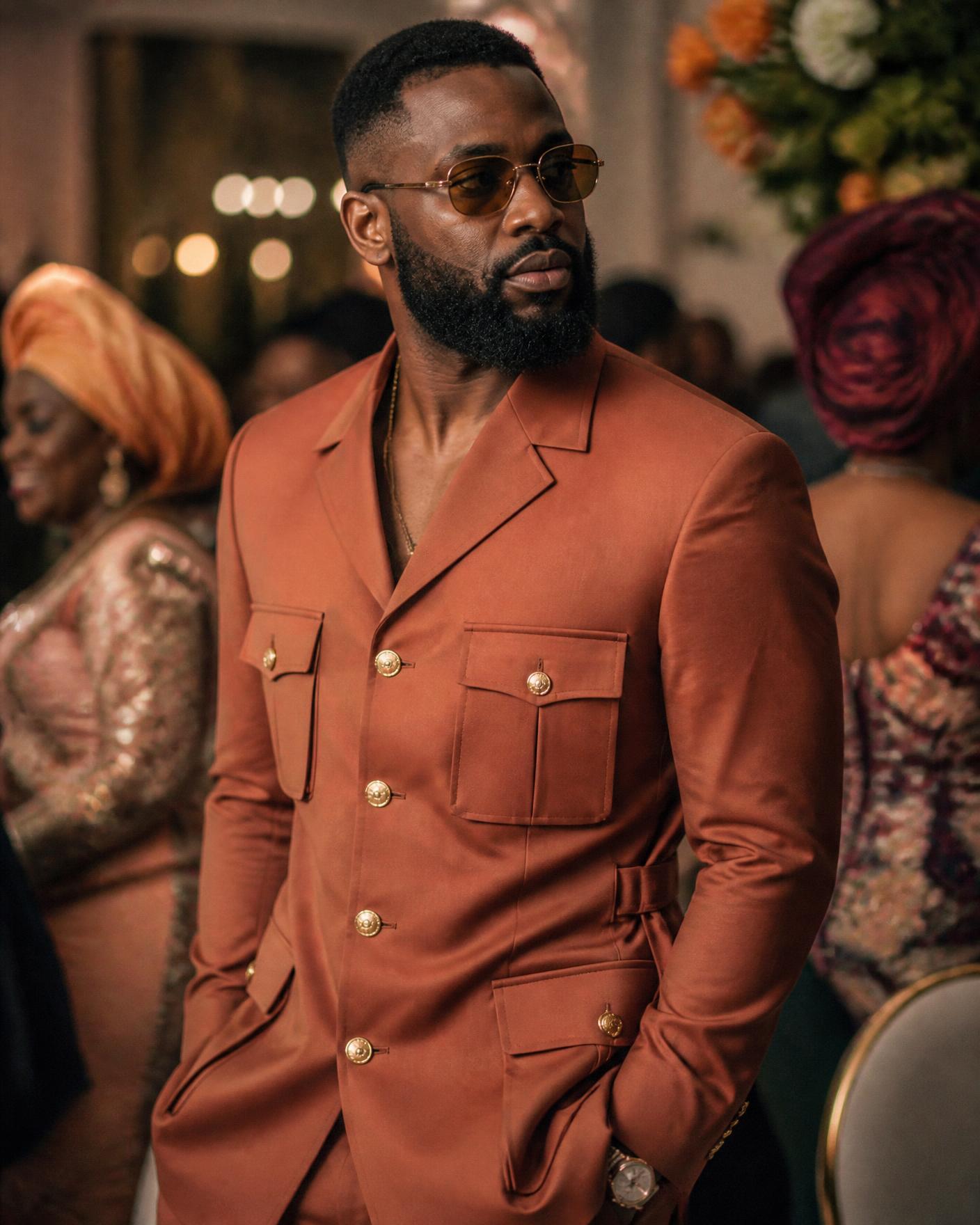
£200–£350 — the set that always works
- Off-the-peg senator set in a matte wool-blend, one tone, no sheen.
- £40–£60 to a tailor: waist suppressed, sleeve shortened, trouser hemmed with a short break.
- Plain leather slip-ons already broken in. One wooden bead bracelet.
This is what I recommend to anyone going to their first owambe in Britain. Nobody has ever looked at me strangely in it.
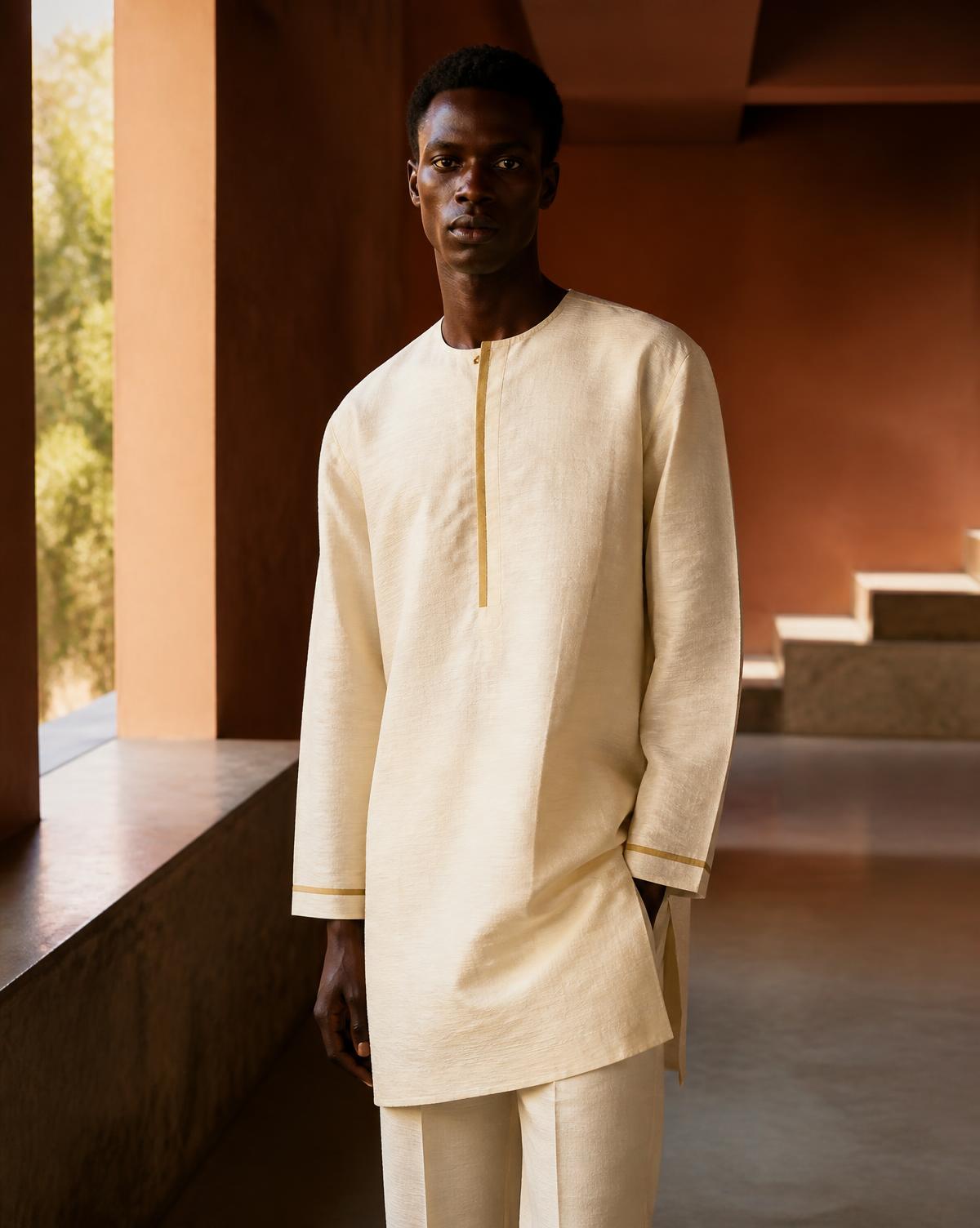
£450–£900 — the outfit built for the night
- Made-to-measure kaftan and trouser in a breathable wool-silk or raw silk, tonal embroidery only.
- Two fittings — three weeks out and one week out. The second one is the one that saves you.
- Woven leather sandals or a soft loafer. Nothing that needs breaking in on the night.
The tier I default to now. Made-to-measure at £600 beats off-the-peg at £900, every time, on every frame.
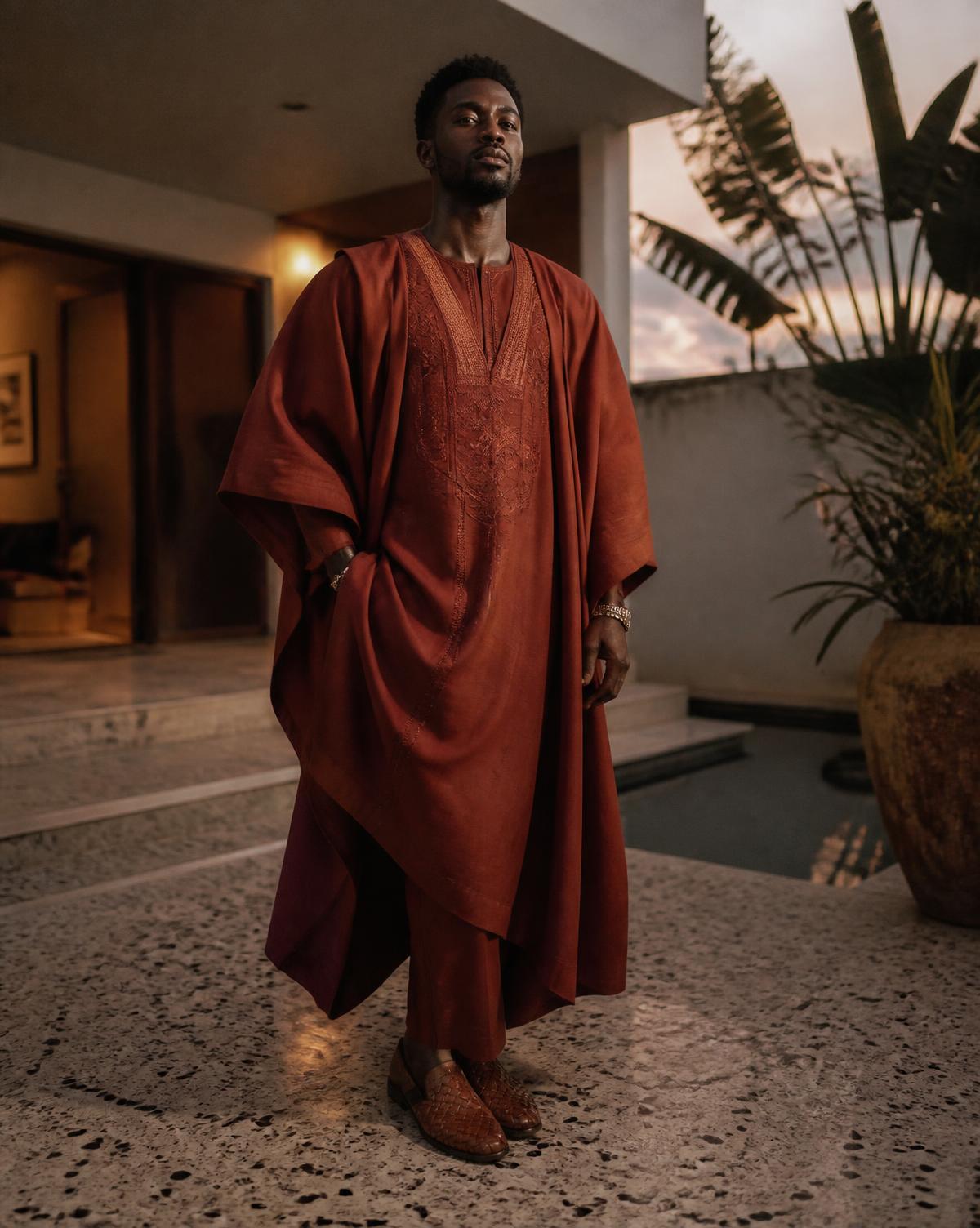
£900–£1,800 — when you are close to the celebrant
- Agbada in fine wool-silk with hand embroidery, cut with a real shoulder and a hem that hangs straight.
- A second, lighter look for the last three hours. Nobody dances in an agbada at midnight.
- Cap fitted properly at the tailor, not bought online and perched.
Worth it for the night you stand in the photographs that get framed. Not worth it twice a year.
07
What to change for your build
The same outfit is a different garment on a different frame. Short version below; the longer one, with looks attached, sits in Build Filter™.
- Broad
- One tone head to toe, soft shoulder, matte cloth, waist taken in. Avoid contrast trousers — they cut you in half at the widest point.
- Tall
- Ask for extra length everywhere, then break the vertical with a visible waist or a two-tone set. Large-scale embroidery reads correctly on you and on almost nobody else.
- Athletic
- Buy for the chest and pay to bring the waist and sleeve in. Skip stretch blends — they cling under hall lighting.
- Slim
- Heavier, textured cloth and a little shoulder structure. Layer: a waistcoat or wrapper gives you the substance the cut will not.
- Shorter
- Matched tone, higher waist, short break, and have the kaftan or agbada shortened rather than worn long.
- Fuller
- Structure over stretch. A clean single-breasted line, matte cloth, one colour, worn slightly longer.
08
Colour, and the one rule I keep
An owambe is a colour event, which is exactly why restraint reads as confidence. My rule: one strong colour, one neutral, one metal. That is the whole palette.
Rust, terracotta, deep forest, oat, bone, espresso and midnight all photograph well under the warm tungsten these halls run on. Pure white goes grey. Pure black goes flat and loses its shape entirely at the back of a room.
Do not wear the celebrant's exact shade unless you were asked to. Do not wear the bride's colour to a reception. And if there is a colour of the day, take one of the two named colours rather than trying to wear both.
09
Cap, shoes, beads, watch
The cap. Fila or abeti aja, fitted at the tailor. A cap bought online without trying it perches, and a perched cap undoes an £800 outfit in every photograph.
Shoes. Broken in, always. Woven leather sandals or a soft loafer for the evening register; a clean leather slip-on for the afternoon. Nothing new, nothing with visible hardware.
Beads. One strand or one bracelet. Coral is traditional and heavy; wood and bone are quieter and more wearable across a long night.
Watch. One, on leather. A metal bracelet catches on embroidery — I have pulled a thread out of a sleeve that way.
What to carry: a folded pocket square you have no intention of displaying, a spare pair of socks, and money for spraying if that is the kind of night it is.
10
The timeline, working backwards
- Eight weeks out: confirm whether you are in aso ebi and who is coordinating the cloth.
- Six weeks: commission anything made-to-measure. This is the deadline men miss, and the reason so many outfits are rushed.
- Four weeks: buy the off-the-peg pieces and book the alterations now, not after the cloth arrives.
- Three weeks: first fitting. Sit down, sit back, raise both arms.
- One week: second fitting, cap fitted, shoes worn around the house for an hour.
- The night before: full outfit on, photographed on your phone under a warm lamp. The camera sees what the mirror forgives.
If you are ordering from Lagos, add four weeks to everything and assume one round of remote adjustments in London when it lands.
11
Mistakes I have made at owambes
- 01A navy suit to a fiftieth, at twenty-three.
- 02Heavy cotton damask in a July marquee.
- 03One outfit for a nine-hour night.
- 04The celebrant's exact shade of burgundy, uninvited.
- 05An agbada bought online, unaltered, five days out.
- 06A cap I had never tried on.
- 07Polyester lace under a photographer's flash.
- 08New leather sandals on a concrete hall floor.
- 09Three bracelets, a chain and a printed shirt at once.
- 10Arriving on time, which meant standing alone for ninety minutes.
12
Who to contact, and what to say
For the cut, the directory is deliberately small — I only list hands I would send a friend to. For the houses, the spotlights say who each one suits and who it does not.
What to say when you make contact: the date, the event and the room, whether you are in aso ebi, your budget as a number rather than a range, and what you dislike about how clothes usually fit you. A tailor who has an opinion about your request is a tailor worth paying.
What to do next
Confirm the aso-ebi cloth first. Everything you commission has to sit beside it.
Tell me the occasion, the date and your budget bracket. Within 24 hours you get back: two or three houses I would actually approach and why those and not others, the alterations to insist on for your build, a realistic timeline for your date, and a short written brief you can hand to the tailor at the first fitting.
- No fee, no commission, nothing sold here.
- If nobody I trust fits your date or budget, I say so.
- Read by me, answered by me.