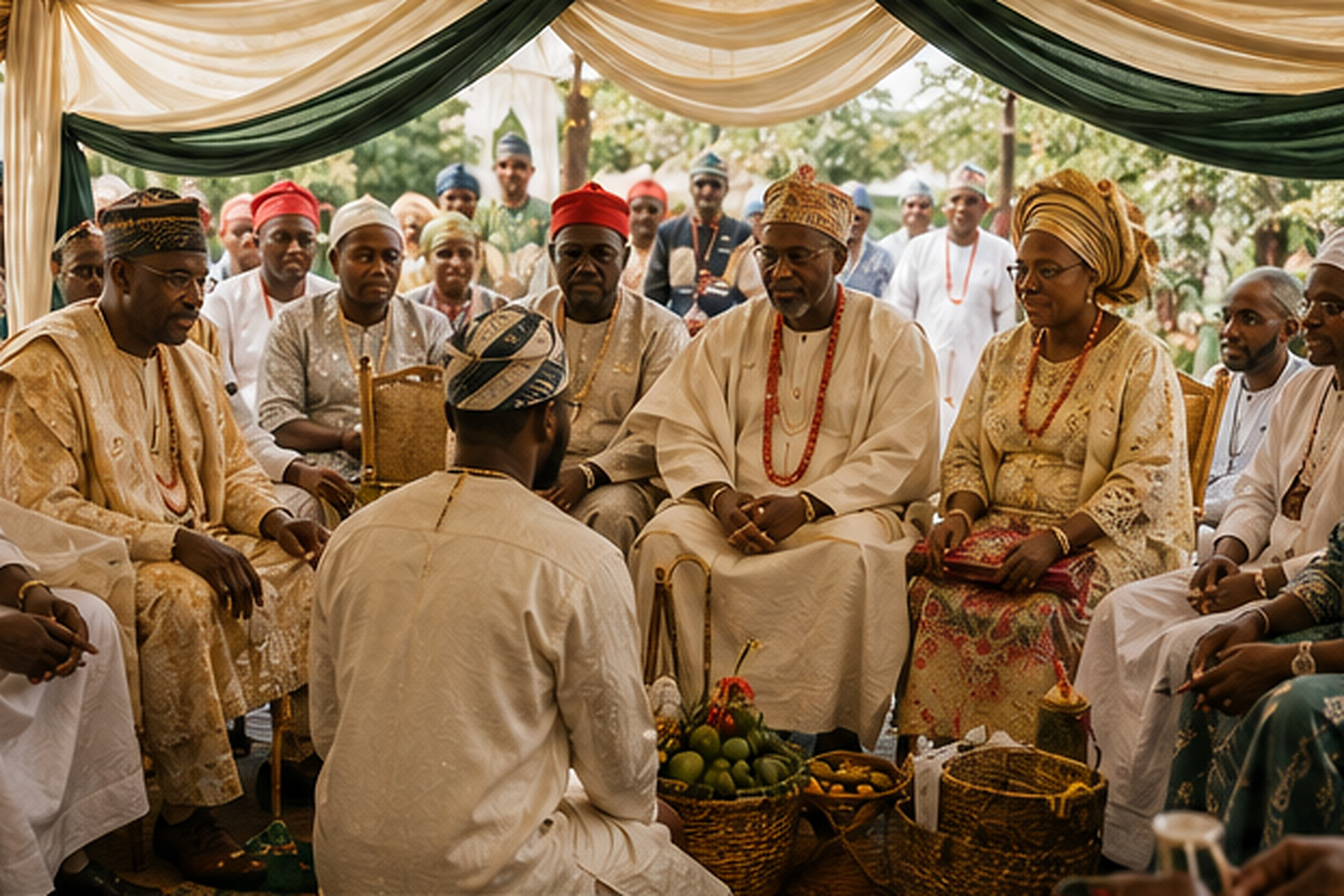
The traditional engagement is the most Nigerian room you will stand in all year, and it is the one most men in Britain dress for as if it were a wedding reception. It is not. It is a negotiation held in public, with photographs.
I have stood in that room as a guest, as a friend of the groom, and once holding a letter I had to read out loud. Everything below is what I have worn, paid for or watched go wrong on somebody I know. Where a figure is a market range rather than something I paid myself, I say so — indicative UK prices for 2026, not quotes.
01
What the day actually is
Two families meet. A letter is read on behalf of the groom's people, an answer is read back, the bride is presented, prayers are said, gifts are exchanged, and the marriage is agreed in front of everybody. An alaga on each side runs the theatre of it, and the theatre is the point.
In Britain it usually happens in a hired hall, a hotel suite or a marquee at the back of a family house, and it is often the morning of the same day as the reception — or, increasingly, the Friday before a Saturday white wedding.
Practically, that means: you will kneel or prostrate at some point, you will sit for two to three hours, you will be photographed head to toe while standing still, and you may need to change afterwards. Dress for all four.
02
Read your role before you read the dress code
The groom. Full ceremonial. Agbada, fitted fila, beads. This is the one occasion where the fullest register is correct rather than showing off, and the one where a rushed outfit is most visible.
The groom's family and groomsmen. One level below the groom, and usually in the family's aso ebi. Same register, quieter cloth, less embroidery. Never a bigger agbada than the man getting married.
The bride's family. Your job is to receive. You will be standing, moving and hosting for hours — choose the register you can host in, which is usually a two-piece rather than a full agbada.
A guest. Traditional attire, tidy, in the colour of the day if one is named. A senator set with real alterations is the whole brief. Nobody is looking at you, which is exactly the freedom you want.
If you have been given a duty — reading the letter, presenting gifts, speaking — you will be in the middle of the floor with a camera on you. Dress one notch up from where you would otherwise sit.
03
Aso ebi across two families
A traditional engagement usually has two aso ebi blocks, one per family, in two different fabrics. Before you buy anything, establish three facts: which side you are counted on, who is coordinating that side's cloth, and when it will physically be in the country.
Cloth arriving four weeks before the day is normal. Cloth arriving two weeks before is not unusual. That single fact should decide your tailor: you want hands that can turn a commission around properly in three weeks, not the best cutter in London with a ten-week book.
If you have not been asked into either block, do not wear either fabric. Standing beside the family in their exact cloth without belonging there is the most avoidable mistake on this page.
04
Agbada, kaftan, senator — and who wears which
Agbada. The ceremonial register. A good one has a real shoulder, a sleeve that falls in a clean curve, and a hem that hangs straight when you sit. A bad one is a sack with embroidery on it, and the difference is cut, not price. Groom, fathers, and anyone with a formal duty.
Kaftan and trouser. The most useful register in the room. Serious enough for the prayers, wearable for six hours, and where made-to-measure buys you the most per pound.
Senator set. Correct for guests almost everywhere. Matte wool-blend, waist and sleeve adjusted, one tone. It is the garment I would tell a man to own first.
A suit. Wrong here, in a way it is not wrong at a reception. The engagement is the traditional half of the marriage; arriving in tailoring reads as a refusal to take part.
05
Cloth for a British hall, in any month
British venues are either eleven degrees with the doors propped open or twenty-six degrees with three hundred people in them, and frequently both in one afternoon. The cloth decides whether you enjoy the day.
Wool-silk (250–300g). The most reliable choice for Britain. Holds a shape in a cold hall, breathes when the room fills, photographs matte. If you buy one cloth for ceremonial dressing, buy this.
Cotton damask and brocade. The traditional choice and the heavy one. Correct for a winter morning ceremony, punishing in a July marquee.
Raw silk and shantung. Dry, slightly crisp, beautiful in daylight. Creases where you sit, which matters at a ceremony where you sit for two hours — so stand for the long readings.
Polyester lace and shiny jacquard. Cheap to buy, expensive to wear. No breathability, and flash photography finds the sheen every time. The engagement is the most photographed hour of the whole marriage; do not shine in it.
The longer version of all of this, with weights and linings, is in Cloth for British weather.
06
Three complete looks, by budget
Indicative UK market ranges for 2026, alterations included — the line almost nobody budgets for and everybody needs. Aso ebi cloth is charged separately by the families, so treat it as an addition rather than part of these figures.
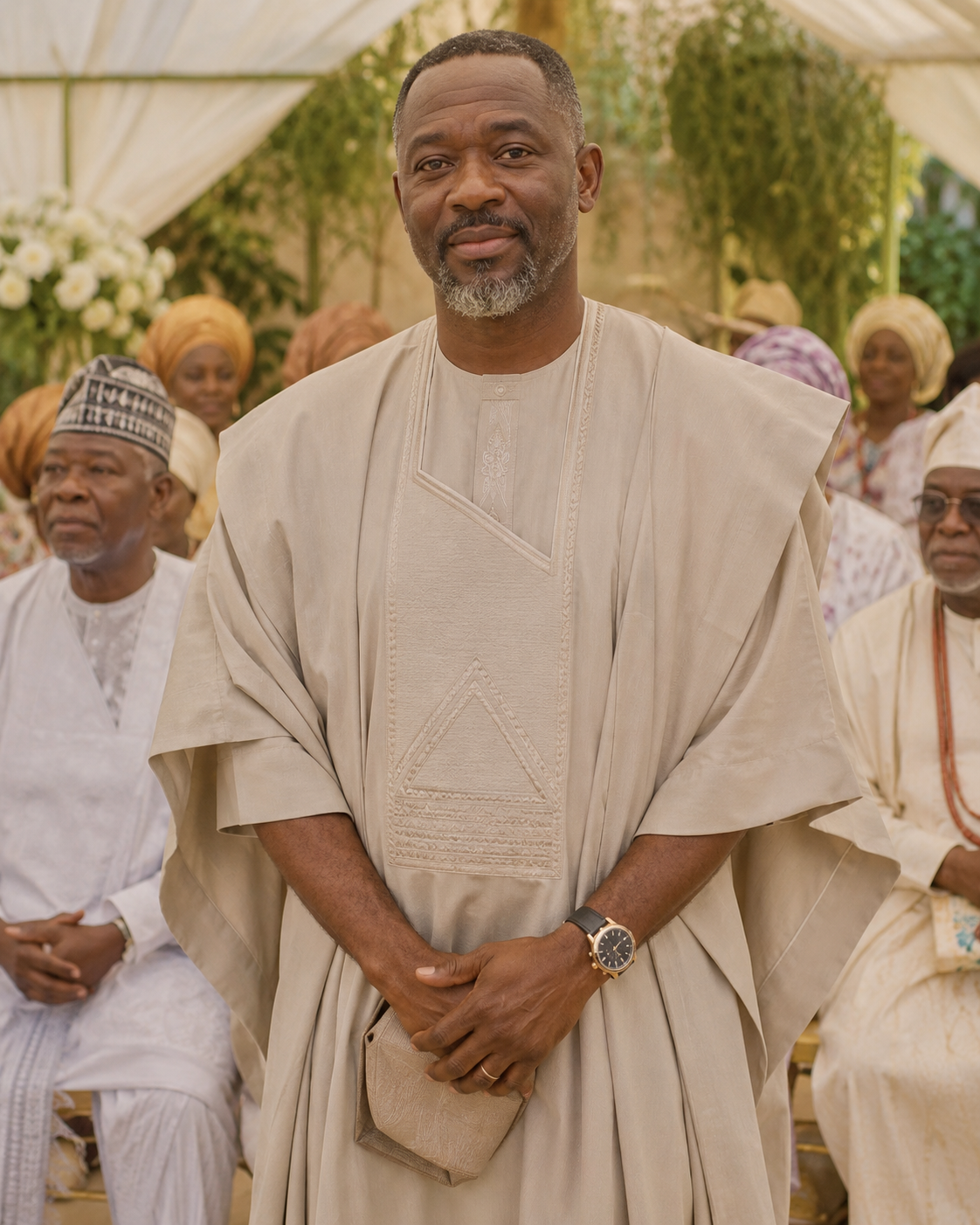
£300–£500 — the guest who got it right
- Off-the-peg senator set or simple kaftan in a matte wool-blend, one tone.
- £60–£90 of alterations: waist suppressed, sleeve to the wrist bone, trouser hemmed with a short break.
- A properly fitted fila, plain leather slip-ons, one bead bracelet.
For a guest this is enough, and it is more than most of the room manages. The alterations are the whole difference.
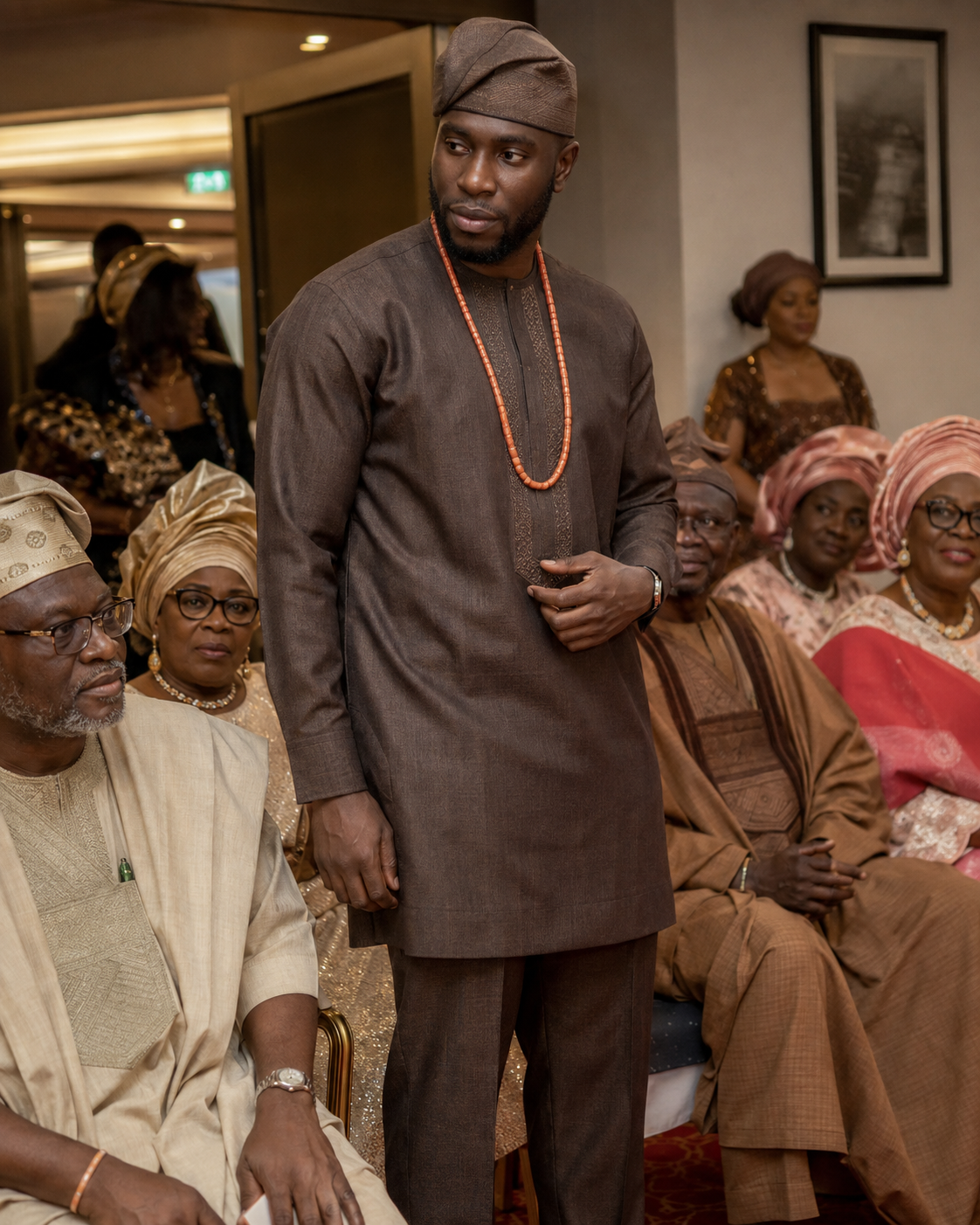
£900–£1,600 — family, or the groomsman standing close
- Made-to-measure two-piece or light agbada in wool-silk, tonal embroidery at the neck only.
- Two fittings — four weeks out, then ten days out with the shoes on.
- Cap made from the same cloth, coral or wood beads, soft loafers already broken in.
The tier I recommend to brothers and close friends. Made-to-measure at £1,100 outdresses off-the-peg at £1,800 on every frame I have seen.
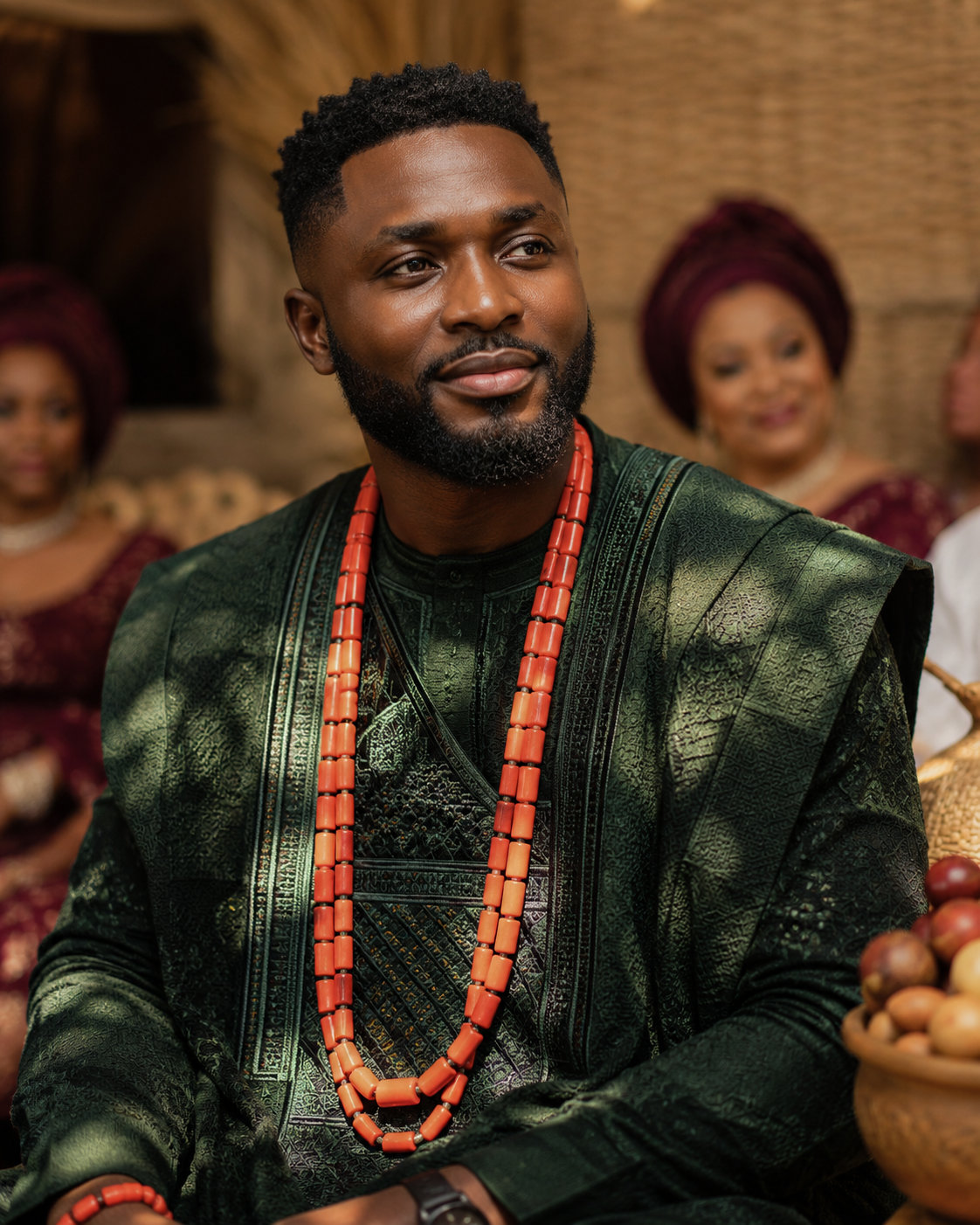
£1,800–£3,500 — the groom
- Full agbada commission with a real shoulder, hand embroidery, and a hem that hangs straight when you sit.
- A second lighter look for the reception — nobody survives a full agbada past the speeches.
- Fila fitted at the tailor, beads chosen against the cloth in daylight, evening shoes worn in.
This is the one day where the full commission earns its money. Budget the second look at the start, not in week ten.
07
What to change for your build
The same commission is a different garment on a different frame. The short version is below; the full one, with named alterations and reference looks, is in Build Filter™ and in What to change for your build.
- Broad
- One tone head to toe, a soft unpadded shoulder, matte cloth, waist taken in. Keep embroidery narrow and central — a wide yoke widens you further.
- Tall
- Add length everywhere, then break the vertical with a visible waist or a two-tone set. Large-scale embroidery and a full agbada sleeve read correctly on you.
- Athletic
- Buy for the chest and pay to bring the waist and sleeve in. Avoid stretch blends — they cling under hall lighting and shine in photographs.
- Slim
- Heavier cloth, a little shoulder structure, and layering. A wrapper or waistcoat gives you the substance the cut alone will not.
- Shorter
- Matched tone, higher waist, short break, and the agbada shortened to just below the knee rather than worn long.
- Fuller
- Structure over stretch. A clean single line, matte cloth, one colour, worn a fraction longer, with the fila kept low and wide rather than tall.
08
Colour, and the two-family problem
There are usually two palettes in play, one per family, and a colour of the day for the couple. Take one colour from your side's palette, one neutral, one metal. That is the whole scheme.
Rust, terracotta, deep forest, oat, bone, espresso and midnight all hold up under the warm tungsten these halls run on. Pure white goes grey on camera. Pure black loses its shape at the back of a room.
Two hard rules: never the couple's exact shade unless you were asked, and never brighter than the groom if you are standing next to him.
09
Fila, beads, staff, shoes
The fila. Fitted at the tailor, in the same cloth where possible. A cap bought online and perched undoes a £1,200 outfit in every photograph. Worn with a slight lean, never square.
Beads. Coral is the ceremonial choice and it is heavy; wood and bone are quieter and easier across a long morning. One strand at the neck and one at the wrist is plenty — the groom can carry more.
A staff or horsetail. Only if it belongs to your role. Carried, not waved. If you are unsure whether it is yours to hold, it is not.
Shoes. Broken in, always, and easy to take on and off — you may kneel or prostrate. Woven leather sandals or a soft loafer; nothing new, nothing with visible hardware.
10
Twelve weeks, working backwards
- Twelve weeks: confirm your role and which family's aso ebi you are in. Everything else follows from this.
- Ten weeks: choose the tailor and hold the slot. Grooms commission now; guests can wait.
- Eight weeks: cloth confirmed and paid for. If it is coming from Lagos, this is your last comfortable date.
- Six weeks: first fitting on the shell. Sit down, sit back, raise both arms, kneel.
- Four weeks: fila fitted, beads chosen against the cloth in daylight, second look decided.
- Ten days: final fitting with the actual shoes on. After this, changes cost you money and goodwill.
- The night before: whole outfit on, photographed on your phone under a warm lamp. The camera sees what the mirror forgives.
Ordering from Lagos adds four weeks and one round of remote adjustment in London when it lands. The full countdown is in Ordering timelines.
11
Mistakes I have made and watched
- 01Wore a suit to my first traditional engagement, at twenty-four.
- 02Bought the aso ebi and left three weeks for the making.
- 03A full agbada with no second look, for a ceremony that ran into a reception.
- 04Heavy cotton damask in a June marquee with no ventilation.
- 05A fila I had never tried on, perched an inch too high all morning.
- 06Polyester jacquard under a photographer's flash — every frame shines.
- 07New leather sandals, and a morning spent kneeling in them.
- 08Stood beside the groom in a brighter colour than his.
- 09Wore the bride's family cloth without being counted in it.
- 10Left the trouser hem long, and knelt in it twice.
12
Who to contact, and what to say
For the cut, the directory is deliberately small — I only list hands I would send a friend to. For the houses, the spotlights say plainly who each one suits and who it does not.
What to say at first contact: the date, that it is a traditional engagement and your role in it, whether you are in aso ebi and when the cloth lands, your budget as a number rather than a range, and what you dislike about how clothes usually fit you.
What to do next
Confirm your role and which family's aso ebi you are in. Every other decision follows from those two facts.
Tell me the occasion, the date and your budget bracket. Within 24 hours you get back: two or three houses I would actually approach and why those and not others, the alterations to insist on for your build, a realistic timeline for your date, and a short written brief you can hand to the tailor at the first fitting.
- No fee, no commission, nothing sold here.
- If nobody I trust fits your date or budget, I say so.
- Read by me, answered by me.