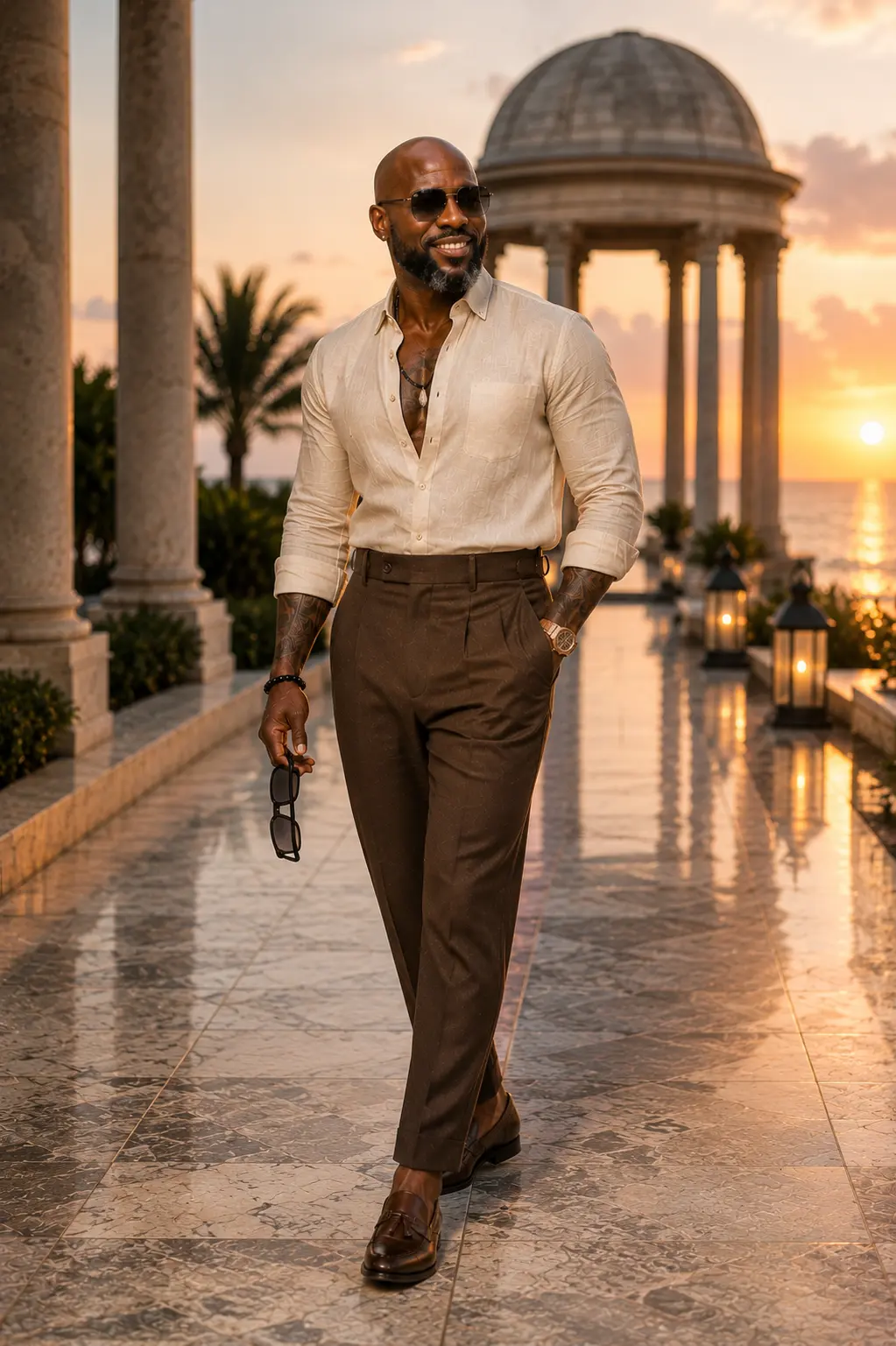
Almost every man I know who thinks he dresses badly is actually wearing the right clothes at the wrong proportions. This page is the whole correction table in one place, so you can read it rather than click through it.
It is the written form of Build Filter™. The tool gives you one answer with reference looks, budgets and climate notes attached; this page gives you all twenty-four at once, to take to a tailor.
01
How to use this page
Find your frame, find the garment you are having made, and read the three or four alterations underneath it out loud at your first fitting. That is the entire method.
Two things to hold on to. First, cut beats size: a £600 commission cut for your frame will out-dress a £1,400 garment bought off a rail. Second, alterations are not an extra — budget £40 to £90 for them on anything off the peg, every time.
Height is a separate correction, applied on top of the frame advice. Both matter, and men usually only think about one.
02
The three height corrections
- Under 5'9"
- Keep the vertical line unbroken — one tone from shoulder to shoe, the waist sat slightly higher, and no break over the shoe. Sleeve folds on an agbada go higher on the arm than the tailor will suggest.
- 5'9" – 6'1"
- You can wear most of these proportions as drawn. Trust the shoulder, get the sleeve length exact, and leave the rest of the tailoring alone.
- 6'2"+
- You need horizontal interest or the silhouette reads stretched — a longer tunic, a wider sleeve drop, a visible waist, and a trouser with weight at the hem.
03
The full matrix, written out
Four builds against six garments — including the aso-ebi set, where the family chooses the cloth and you only control the cut, and the lighter reception look most men skip. Every entry gives the silhouette strategy, the named alterations, the cloth, and the houses I would actually approach for that combination.
Wide shoulders, athletic through the chest
Broad / Muscular
Broad / Muscular · Agbada
Stiff, heavy cloth stacks volume straight onto shoulders you already have. Choose soft-drape wool, silk-cotton or polished cotton so the garment falls rather than sits.
Ask for
- Deepen the armholes on the inner tunic by an inch or so for real movement.
- Set the outer sleeve fold at the wrist bone — any longer and the arms read heavier.
- Taper the inner top gently toward the waist so it does not box out.
Cloth
Light-to-medium polished cotton or a soft silk brocade. Skip stiff aso-oke.
Where I would go
- Tee Apparel — Lagos. Architectural cuts, lighter agbada cloth.
- KNF Couture — Lagos. Clean-drape ceremonial sets.
Broad / Muscular · Senator / Kaftan
Zero shoulder padding, a clean vertical placket, and a mid-height grandad collar. The shape should come from the cut, not from structure.
Ask for
- Generous side vents, six to eight inches, so it does not ride over the hips.
- Light waist suppression on the top — shaped, never clinging.
- Straight-leg trouser with a half-inch break.
Cloth
120s–140s wool, or a high-twist wool blend that holds its line in a warm hall.
Where I would go
- Looks Like A Good Man — Lagos. Proportional separates and modern sets.
- Curban Place — London. Subtle-taper two-piece sets.
Broad / Muscular · Occasion Suit
Soft canvas or unstructured shoulders, a natural chest line, and a slightly wider lapel to balance the width you carry.
Ask for
- Let out the centre back seam for arm extension.
- Flat-front trousers with side adjusters rather than a belt.
Cloth
Tropical wool, hopsack, or a wool-linen blend for a British summer wedding.
Where I would go
- KNF Couture — Lagos. Bespoke precision suiting.
- Soboye — London. Tailored occasion pieces.
Broad / Muscular · Dinner Jacket
A peak lapel cut slightly wider than standard reads as intent rather than bulk on a broad chest. One button, closed, with a clean chest and no ripple across the blade.
Ask for
- Peak lapel taken out to the shoulder line — a narrow lapel makes the chest look inflated.
- Extra room across the back blades, taken out of the centre seam, not the sides.
- Trousers with side adjusters and a single braid stripe; no belt loops on black tie.
Cloth
Matte midnight barathea or a mohair-wool blend. Nothing with sheen across the chest.
Where I would go
- KNF Couture — Lagos. Structured evening tailoring.
- Soboye — London. Evening pieces with a soft shoulder.
Broad / Muscular · Aso-Ebi Set
You do not choose the cloth, so the only lever you have is the cut. Take the family lace or aso-oke and have it made as a straight, softly shaped top with no shoulder structure at all — stiff cloth plus a broad shoulder is where aso-ebi goes wrong.
Ask for
- No shoulder pad and no interlining across the chest — let the cloth sit flat on your own shoulder line.
- Deepen the armhole and finish it in plain cotton so lace does not saw at your arm all day.
- Gentle waist shaping through the back seam only, so the top does not box out over the hips.
Cloth
You are given the cloth. Control the lining: cotton, not acetate, and unlined through the body wherever the family will accept it.
Where I would go
- Tee Apparel — Lagos. Cutting supplied family cloth cleanly.
- Curban Place — London. Working with lace and aso-oke yardage.
Broad / Muscular · Lighter Reception Look
Drop all the structure. A short-sleeve kaftan or an unstructured overshirt in one tone, cut with room across the back so you can move — the second change should look easier than the first, not smaller.
Ask for
- Unlined body, side seams left generous through the chest and blades.
- Sleeve finished at the wrist bone or rolled cleanly above the elbow — nothing in between.
- Straight-leg trouser with a soft waistband and side adjusters.
Cloth
Irish linen, linen-cotton or a high-twist wool in a single quiet tone.
Where I would go
- Looks Like A Good Man — Lagos. Relaxed reception separates.
- Soboye — London. Soft unstructured evening pieces.
Long limbs, narrower chest
Tall & Lean
Tall & Lean · Agbada
You carry heavy, textured cloth better than anyone. Use a wide sleeve drop to anchor all that vertical line.
Ask for
- Extend the outer wingspan by a couple of inches for a proper horizon.
- Land the inner tunic hem two inches above the kneecap.
Cloth
Structured aso-oke, heavy cording, damask.
Where I would go
- Lucky Enemuo Afrika — Lagos. Heavy ceremonial aso-oke and agbada.
- FAI World — Lagos. Statement silhouettes.
Tall & Lean · Senator / Kaftan
A high grandad collar and structured cuff give you presence. A slightly wider leg keeps the proportion honest.
Ask for
- A whisper of shoulder padding to square the frame off.
- No extreme taper — keep the leg opening at eight inches or more.
Cloth
Structured cotton damask or a medium-weight suiting wool.
Where I would go
- Soboye — London. Adire and tailored structured sets.
- OAK Collection — Lagos. Long, clean ceremonial lines.
Tall & Lean · Occasion Suit
Double-breasted or three-piece adds depth. A ticket pocket and turn-ups break the vertical line in your favour.
Ask for
- Jacket length must fully cover the seat.
- Inch-and-a-half turn-ups to weight the hem.
Cloth
Flannel, heavy linen, or a textured tweed for autumn and winter dates.
Where I would go
- KNF Couture — Lagos. Structured double-breasted suiting.
- Maye Tobs — Lagos. Considered occasion tailoring.
Tall & Lean · Dinner Jacket
A double-breasted or shawl-collar jacket with a visible waist stops the whole thing reading as a column. Depth beats slimness on your frame.
Ask for
- Jacket cut long enough to cover the seat — most off-the-peg evening jackets are two inches short on you.
- A cummerbund or low waistcoat to mark the waist and break the vertical.
- Sleeve set to show a half-inch of cuff, no more, or the arms read longer still.
Cloth
Midnight barathea in winter, or velvet with real weight for a December dinner.
Where I would go
- Soboye — London. Long, considered evening lines.
- KNF Couture — Lagos. Double-breasted evening cuts.
Tall & Lean · Aso-Ebi Set
Family cloth suits you: texture and pattern give your frame the horizontal weight it wants. Ask for the fuller version of whatever the family has agreed — the longer top, the wider sleeve, the four-piece rather than the two.
Ask for
- Top cut long, to mid-thigh, so the vertical is broken once rather than never.
- Wider sleeve or a proper sleeve drop if the cloth allows it.
- A visible waist — a wrapped or belted detail if the family style permits, or a shaped back seam if not.
Cloth
The cloth is given. Where you have a say, choose the heavier of the two options offered; weight hangs better on you.
Where I would go
- Lucky Enemuo Afrika — Lagos. Heavy aso-oke and family sets.
- FAI World — Lagos. Statement cuts from supplied cloth.
Tall & Lean · Lighter Reception Look
A relaxed set with weight at the hem, or a soft double-breasted overshirt. Avoid the slim single-tone kaftan — on your frame it reads as a column in a photograph taken across a room.
Ask for
- Wider leg opening, eight inches or more, with a turn-up or a weighted hem.
- Patch pockets and a chest pocket to give the front something to read.
- Top or overshirt cut long enough to cover the seat.
Cloth
Textured linen, a slubby linen-silk, or a light cotton damask — texture over sheen.
Where I would go
- Soboye — London. Long, relaxed reception pieces.
- OAK Collection — Lagos. Clean, generous evening separates.
Balanced frame, less height to play with
Shorter / Compact
Shorter / Compact · Agbada
One tone across agbada, tunic and trouser so nothing cuts you in half. Sleeve folds sit higher on the arm than tradition suggests.
Ask for
- Shorten the inner tunic to three inches above the kneecap.
- Scale the chest embroidery down — full-size motifs swallow a shorter torso.
Cloth
Monochrome silk-cotton or a fine polished cotton.
Where I would go
- Tee Apparel — Lagos. Scaled agbada embroidery.
- Curban Place — London. Proportional modern sets.
Shorter / Compact · Senator / Kaftan
Vertical lines and a hidden placket keep the eye travelling up. Nothing horizontal across the chest.
Ask for
- No break over the shoe — a continuous line from waist to floor.
- Slimmer sleeve, no excess at the cuff.
Cloth
Matte wool crepe or a smooth cotton twill.
Where I would go
- Curban Place — London. Proportional modern kaftans.
- Looks Like A Good Man — Lagos. Well-judged separates.
Shorter / Compact · Occasion Suit
Single-breasted, two-button, with a slightly higher stance to lengthen the leg.
Ask for
- Jacket length cut to the thumb knuckle, not an inch longer.
- Trousers finished with no break.
Cloth
Smooth high-twist worsted wool in a single tone.
Where I would go
- KNF Couture — Lagos. Clean single-breasted suiting.
Shorter / Compact · Dinner Jacket
One tone from collar to shoe, a shorter jacket, and a higher trouser waist. Black tie is the easiest place to buy height, as long as nothing cuts across you.
Ask for
- Jacket shortened to just cover the seat — no longer.
- Trousers cut at the natural waist so the leg starts higher; no break over the shoe.
- Shawl collar rather than a wide peak, kept narrow enough not to crowd the chest.
Cloth
Matte black or midnight barathea, single tone throughout, patent or highly polished shoes.
Where I would go
- KNF Couture — Lagos. Precise evening proportion.
- Curban Place — London. Proportional evening tailoring.
Shorter / Compact · Aso-Ebi Set
Scale is the whole battle. The family cloth will have a pattern repeat sized for nobody in particular — have the tailor place it so the largest motif does not land across your middle, and keep the top shorter than the group standard.
Ask for
- Top hemmed two to three inches shorter than the tailor's default, sat above the widest part of the hip.
- Pattern placement agreed before cutting — motif off the waistline, running vertically where possible.
- Trouser at the natural waist, no break over the shoe, in the closest tone to the top.
Cloth
The cloth is given. If there is a choice of colourway, take the quieter, smaller-patterned one; large repeats shorten you.
Where I would go
- Curban Place — London. Proportional cutting of supplied cloth.
- Tee Apparel — Lagos. Scaling pattern and embroidery to frame.
Shorter / Compact · Lighter Reception Look
One tone, top to shoe, in a light cloth — the reception is the easiest place on the day to buy height. A short kaftan or a trim overshirt worn out, nothing layered across the chest.
Ask for
- Top cut to the hip bone, no lower.
- Higher trouser waist so the leg starts sooner; no break at the shoe.
- Slim sleeve, finished at the wrist bone, no cuff bulk.
Cloth
Matte linen-cotton or a fine cotton in a single tone, no contrast trim or panelling.
Where I would go
- Curban Place — London. Proportional modern separates.
- Looks Like A Good Man — Lagos. Well-judged relaxed sets.
Oval profile, broader midsection
Full-Figured
Full-Figured · Agbada
The agbada is your strongest garment. Structured cloth holds an architectural box shape and drapes straight past the midsection.
Ask for
- Curved front hem on the inner top so it sits cleanly over the stomach.
- A wider tunic cut for breathability through a long day.
Cloth
Heavy corded cloth, structured damask, firm aso-oke.
Where I would go
- Lucky Enemuo Afrika — Lagos. Full-bodied ceremonial wear.
- Tee Apparel — Lagos. Structured agbada architecture.
Full-Figured · Senator / Kaftan
A central vertical placket anchors the look. Curved hems sit far better than a flat square cut.
Ask for
- Trousers at the natural waist with internal adjusters, never a tight belt.
- Deep side slits so you can sit comfortably for hours.
Cloth
Medium-weight wool crepe or a matte polished cotton.
Where I would go
- Looks Like A Good Man — Lagos. Relaxed tailored kaftans.
- OAK Collection — Lagos. Generous, clean ceremonial cuts.
Full-Figured · Occasion Suit
Single-breasted with a lower button stance reads as a clean V rather than a squeeze.
Ask for
- Pleated trousers for comfort through the thigh and waist.
- A softer waistband construction.
Cloth
Matte, darker worsted wools — nothing with sheen.
Where I would go
- KNF Couture — Lagos. Bespoke tailoring.
- Maye Tobs — Lagos. Occasion suiting with ease.
Full-Figured · Dinner Jacket
Single-breasted, one button, lower stance, with a long shawl or peak lapel running a deep V down the chest. A cummerbund does more for you than a waistcoat.
Ask for
- Button stance dropped so the lapel line runs long and open.
- A cummerbund rather than a low waistcoat — it covers the waistband without adding a horizontal.
- Pleated evening trousers on a soft waistband, sat at the natural waist.
Cloth
Matte midnight or black barathea, fully matte facings. Avoid satin panels across the front.
Where I would go
- KNF Couture — Lagos. Evening tailoring with ease.
- Maye Tobs — Lagos. Comfortable formal cuts.
Full-Figured · Aso-Ebi Set
Ask for the longer, straighter version of the family set. A curved hem and a full, straight-cut body take the cloth past the midsection instead of gripping it — and buy extra yardage, because corrections on supplied cloth are otherwise impossible.
Ask for
- Curved front hem on the top so it sits cleanly over the stomach.
- Full straight body with deep side slits, cut for a long day seated.
- Extra yardage ordered with the family purchase so the tailor has room to correct.
Cloth
The cloth is given. Where you can influence it, firmer cloth holds a shape past the midsection; soft clinging lace does not.
Where I would go
- Lucky Enemuo Afrika — Lagos. Full-bodied sets from family cloth.
- Maye Tobs — Lagos. Generous ceremonial cutting.
Full-Figured · Lighter Reception Look
A long, straight kaftan or overshirt with a central placket, worn out over a soft trouser. Nothing tucked, nothing belted at the waist — the aim is one uninterrupted plane in a light cloth.
Ask for
- Central vertical placket, curved hem, cut straight through the body.
- Pleated or forward-pleated trouser on a soft waistband at the natural waist.
- Deep side slits and an unlined body so you can sit and eat comfortably.
Cloth
Matte linen-cotton or a fine polished cotton in a mid-to-dark tone. No sheen, no clinging silk.
Where I would go
- OAK Collection — Lagos. Generous, clean relaxed cuts.
- Looks Like A Good Man — Lagos. Comfortable reception separates.
04
The words to use with a tailor
Alterations go wrong most often because of vocabulary, not skill. These are the phrases that get understood first time, in London and in Lagos.
- "Suppress the waist, don't take in the side seam." Shape, not tightness.
- "Sleeve to the wrist bone." A fixed point on your body, not a measurement in inches.
- "Short break" or "no break." How the trouser meets the shoe. Say it, and bring the shoes.
- "Open the quarters." How much the jacket front sweeps away — the single most useful request for a fuller frame.
- "Deepen the armhole." Movement. Ask for it before the cloth is cut, because afterwards it is not available.
- "Soft shoulder, no pad." Say it twice for an agbada; the default is usually more structure than a broad frame needs.
The full conversation — what to send at first contact, what to ask before you pay a deposit, and how to request a change without fighting the cutter — is in How to brief a tailor.
05
Where to take it
Run your own combination through the tool for reference looks, indicative budgets and the climate notes for that garment. Then read the guide for the occasion you are actually dressing for, because the register changes what you commission.
What to do next
Take three alterations to your next fitting, in these words, and bring the shoes you will wear.
Tell me the occasion, the date and your budget bracket. Within 24 hours you get back: two or three houses I would actually approach and why those and not others, the alterations to insist on for your build, a realistic timeline for your date, and a short written brief you can hand to the tailor at the first fitting.
- No fee, no commission, nothing sold here.
- If nobody I trust fits your date or budget, I say so.
- Read by me, answered by me.