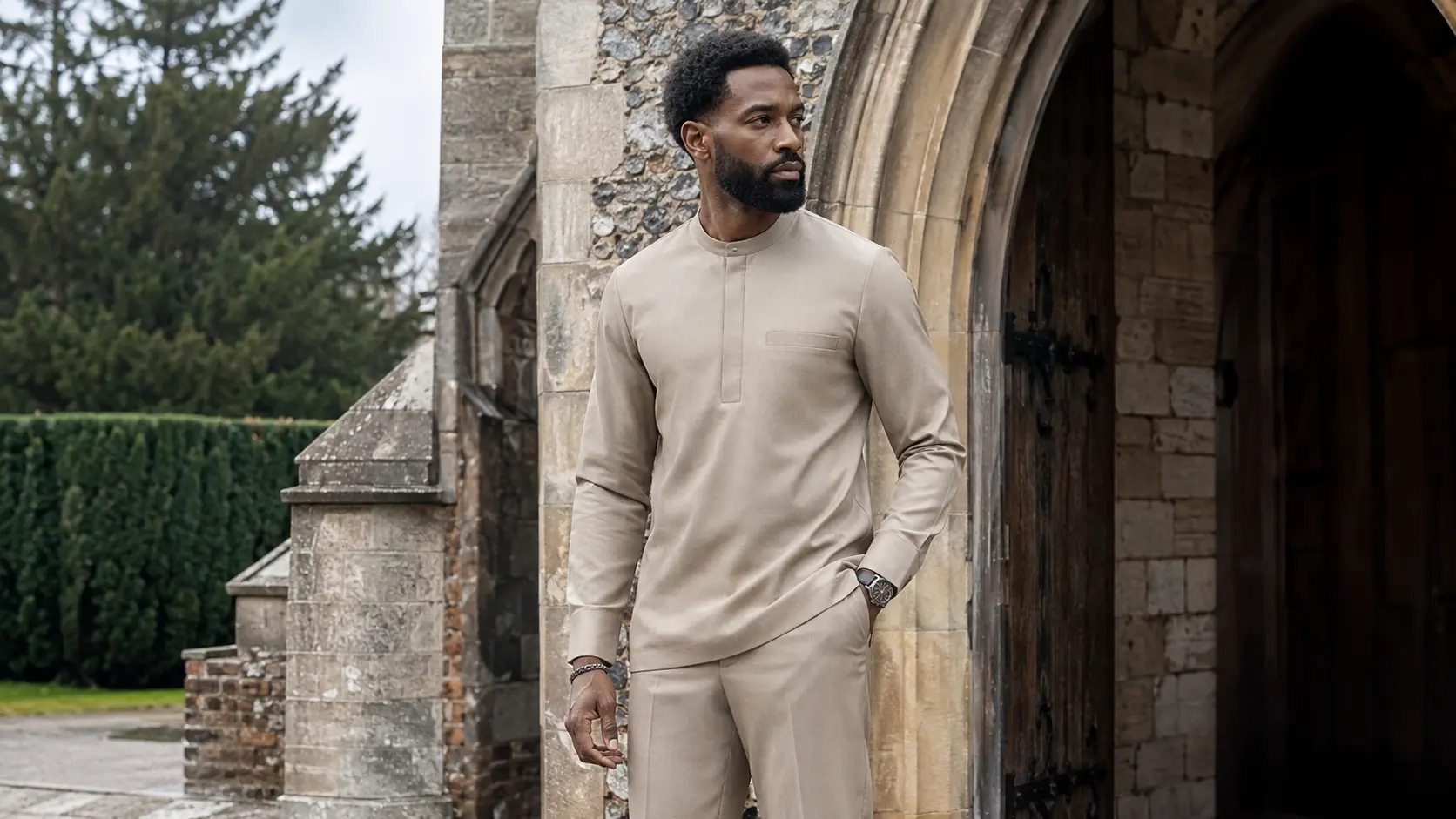
Sunday is the register most Nigerian men in Britain actually dress in, week after week, and the one nobody writes about. It is also where the habit is formed — if your clothes fit on a Sunday, they will fit at a wedding.
This is the quietest guide in the series, on purpose. Figures are indicative UK market ranges for 2026 unless I say I paid them myself.
01
The quieter register
Everything an owambe rewards — scale, colour, embroidery, presence — a church morning quietly penalises. The room is bright, the seating is long, and the person everybody should be looking at is not you.
The rules I keep: matte cloth, one strong colour at most, no sheen, no visible logo, shoes you can kneel in, and a fit tidy enough that nobody has to notice it.
Under-dressing slightly is safe here. Over-dressing is not, and it is the most common error among men who dress well for parties and have never thought about Sundays.
02
What the building is asking for
Anglican and Catholic parishes. Formal and restrained. A quiet suit or a plain senator set. Cap off inside for most Anglican congregations — watch the men your father's age and copy them.
Pentecostal and charismatic churches. Fuller dressing, more colour, more native, and a service that runs long. Comfort matters more here than anywhere: you will stand for stretches of it.
Redeemed, Winners, Deeper Life and similar. Traditional attire is entirely at home, and the congregation reads it as respect rather than display — provided the cloth is matte and the fit is honest.
A wedding or funeral service. A different brief altogether, set by the family. Ask, and follow what you are told exactly.
03
Christenings, dedications, first communions
These are Sunday services with a family occasion attached. Dress a notch above your ordinary Sunday and a clear notch below a wedding.
Father or godparent: you will be at the front and named aloud. Made-to-measure kaftan, ceremonial two-piece, or a very well-altered senator set. Nothing rough at the shoulder — you will be holding a child.
Guest: Sunday best, plus the colour of the day if one has been named. Cash in an envelope, and one free hand.
The reception afterwards is the warm room. Layer for it rather than choosing a heavier garment. The naming and thanksgiving version of all of this is in Naming ceremonies and thanksgivings.
04
Native or suit — how to choose
Senator set. The default, and the most useful garment on this site. Matte wool-blend, one tone, waist and sleeve adjusted.
Kaftan and trouser. Comfortable through a long service, and made-to-measure buys more here per pound than in any other register.
A suit. Entirely correct in a parish church. Mid-grey, olive, brown or navy; a white or pale blue shirt; a quiet tie or none. This is the one occasion where a suit reads better than native for some congregations.
Agbada. Save it for the christening, the thanksgiving, or the Sunday you are being honoured. On an ordinary week it reads as announcement.
05
Cloth for a cold church and a warm hall
British churches in winter are cold in a specific way — stone, high ceilings, ninety minutes seated. The hall afterwards is twenty-four degrees. One outfit has to do both.
Wool-blend (280–320g). The Sunday workhorse. Matte, warm enough for the nave, holds a press through the day.
Wool-silk (250–300g). Better in daylight, dry lustre, photographs matte. The best single cloth if you want one outfit for church and for family occasions.
Flannel and heavier wool (330g+). Winter only, and only if you can remove a layer at the reception.
Cotton and cotton-linen. Summer mornings, in a real weight. Under 200g it will not survive to lunch.
Anything shiny. No. Morning light and camera flash both find it, and on a Sunday it is the wrong signal entirely.
Weights, linings and what fails under flash: Cloth for British weather.
06
Three complete looks, by budget
Indicative UK market ranges for 2026, alterations included. The alterations line is the one that decides whether the outfit works.
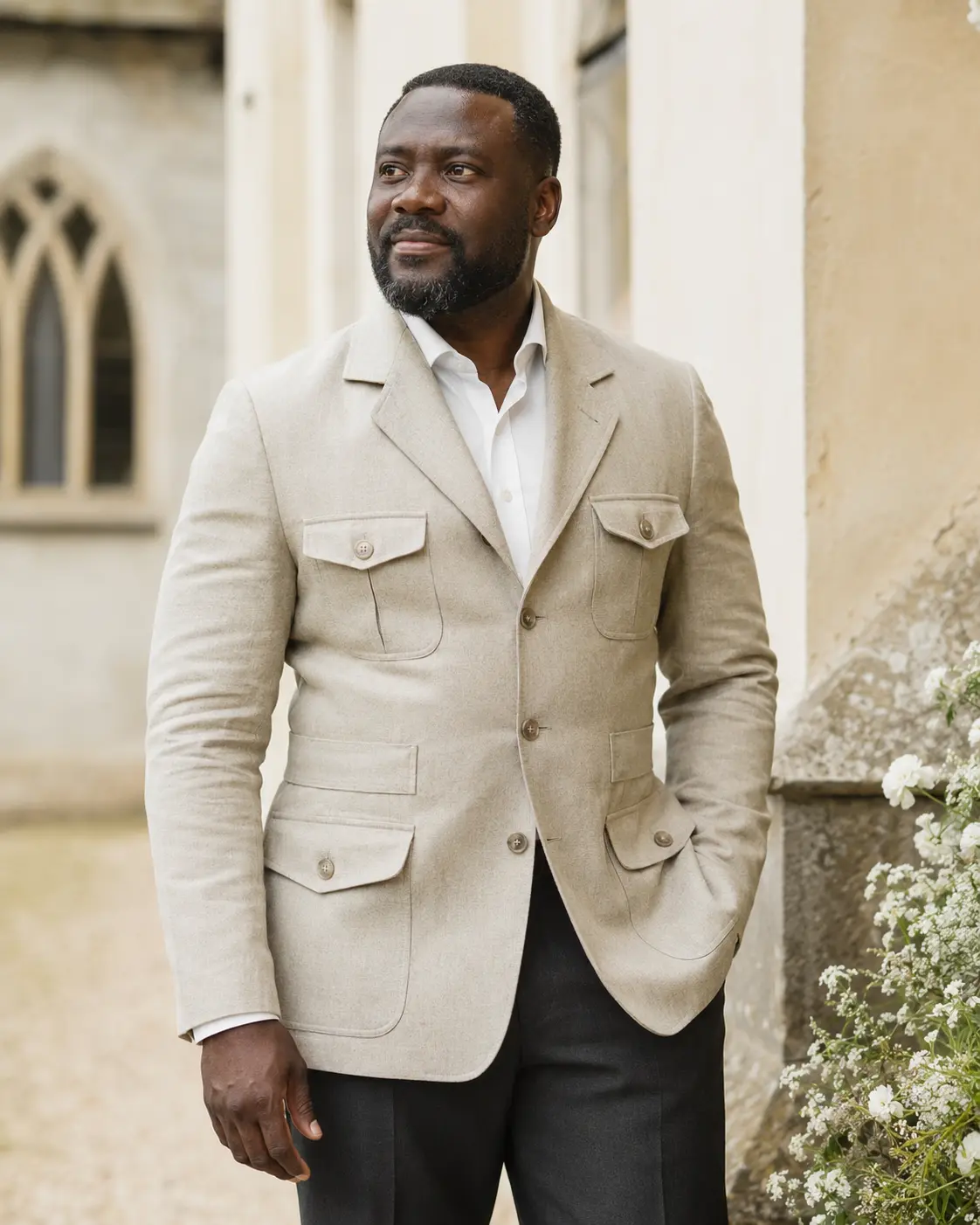
£180–£320 — the Sunday standard
- Senator set in a matte mid-weight wool-blend — stone, oat, olive or espresso.
- £40–£60 of alterations: waist suppressed, sleeve to the wrist bone, short break.
- Broken-in leather slip-ons, no jewellery beyond a watch on leather.
The first outfit I would tell any man to buy. Correct at church, at a naming, at a thanksgiving and at most work dinners.
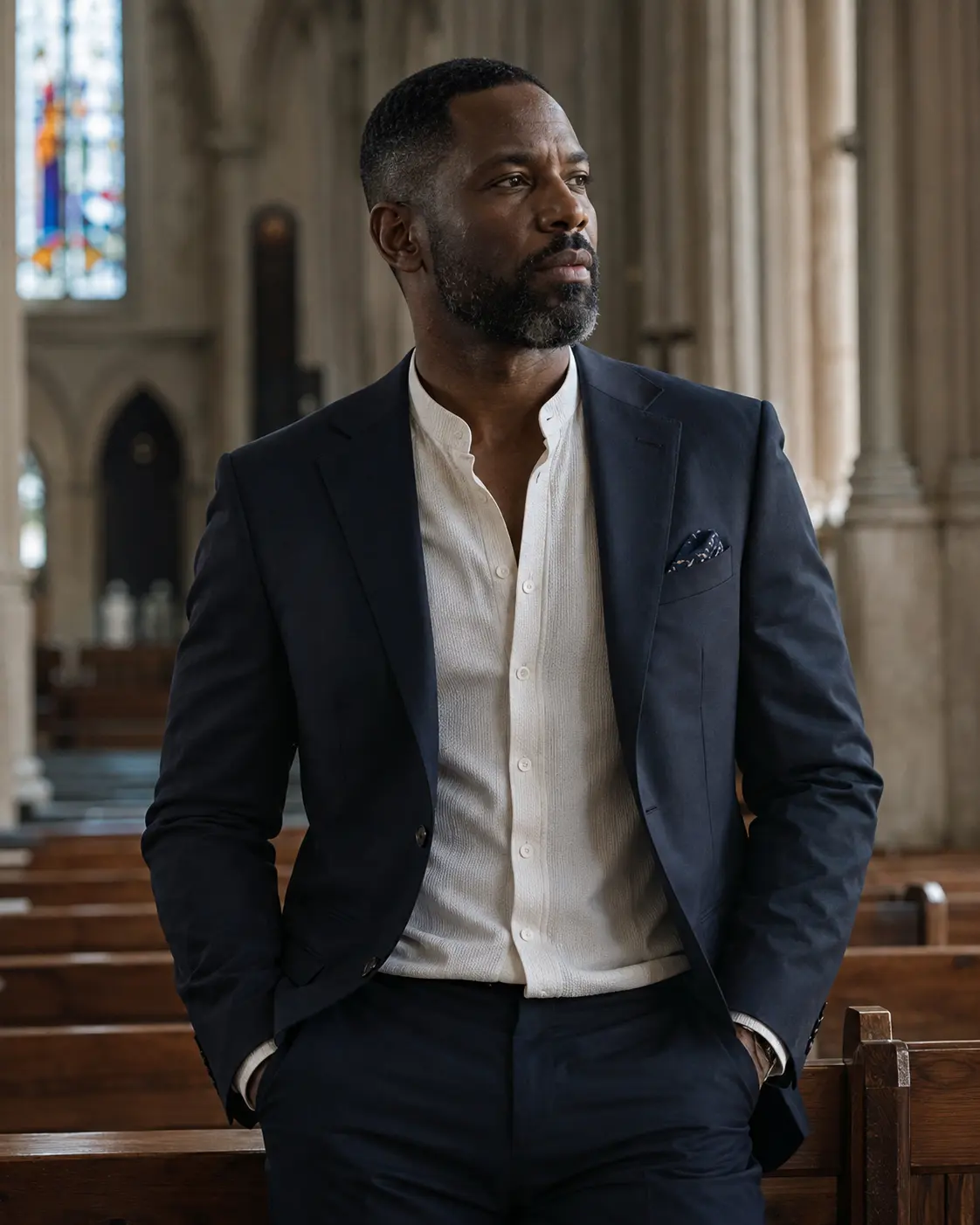
£400–£800 — the Sunday you are needed at the front
- Made-to-measure kaftan or two-piece in 260–300g wool-silk, tonal detail only.
- A light waistcoat or overshirt so one outfit covers a cold nave and a warm hall.
- Soft loafers, one bead bracelet, a fitted cap you can remove during prayer.
The tier that pays back fastest, because you will wear it forty Sundays a year rather than once.
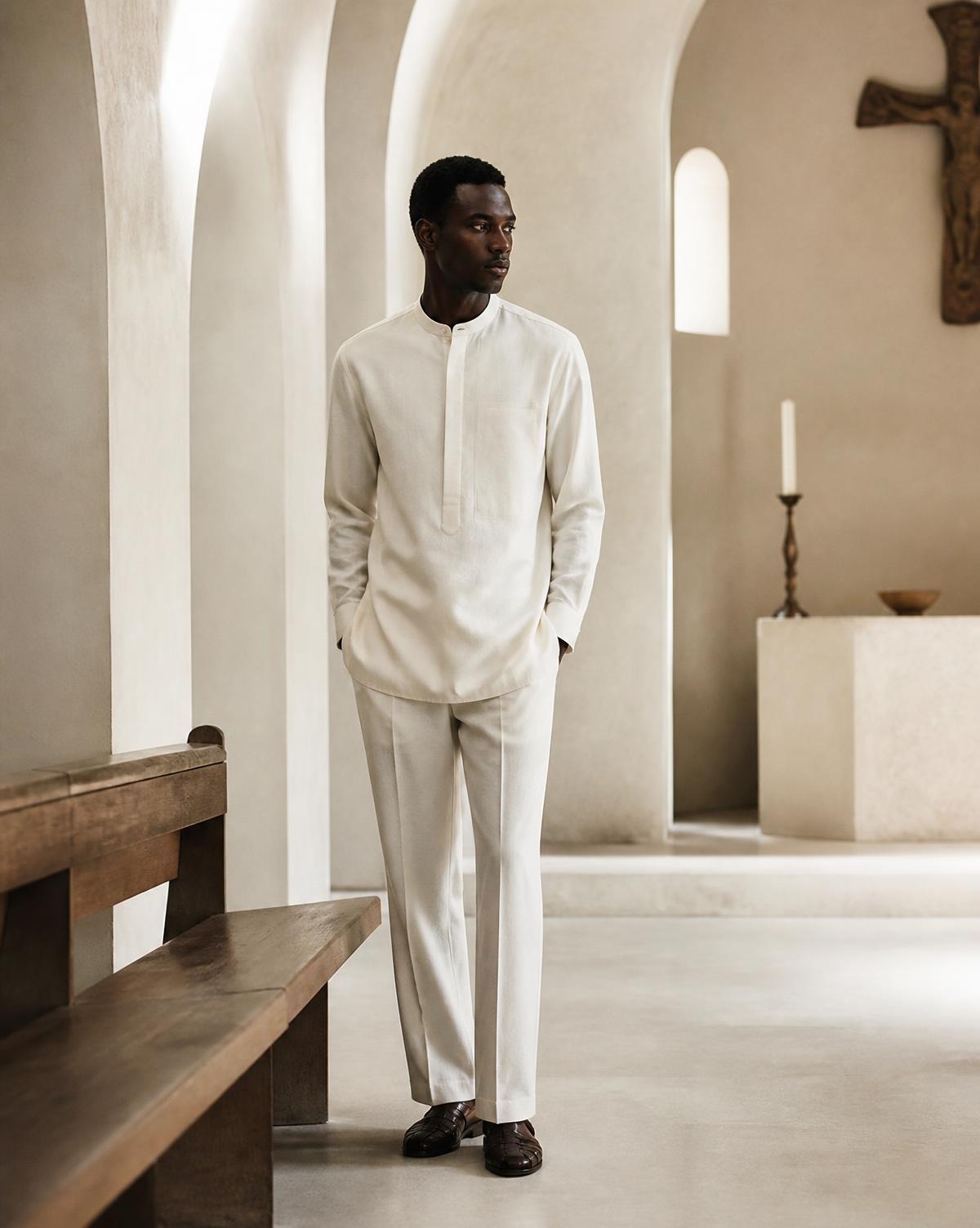
£850–£1,600 — christening, dedication, thanksgiving
- Light agbada or ceremonial two-piece in wool-silk with a real shoulder and a straight hem.
- Coordinated with the mother's cloth rather than matched to it.
- Fitted fila, worn-in evening-weight shoes, and a plan for four hours of being photographed.
Worth it for the days that get printed and framed. Not worth it for an ordinary Sunday.
07
What to change for your build
Short version below; the full set of named alterations is in Build Filter™ and What to change for your build.
- Broad
- One tone, soft shoulder, matte cloth, waist taken in. A two-button jacket with a lower button stance lengthens you.
- Tall
- Extra body and sleeve length, then break the vertical with a waistcoat or a two-tone set. Avoid a short jacket over a long torso.
- Athletic
- Buy for the chest, pay to take in the waist and sleeve. In a heated church, skip stretch blends entirely.
- Slim
- Heavier textured cloth, a hint of shoulder, and a third layer. Substance comes from cloth weight, not from a bigger size.
- Shorter
- Matched tone, higher waist, short break, shorter jacket or kaftan body. Vertical lines everywhere.
- Fuller
- Structure over stretch. Single-breasted, matte, one colour, worn a fraction longer, with an open quarter to the jacket.
08
Colour on a Sunday
Oat, stone, sand, espresso, olive, deep forest, muted rust and midnight all work in a bright church and in a photograph taken on the steps afterwards.
Pure white goes grey under most church lighting. Pure black flattens and reads funereal in the wrong month. Bright royal blue and hard purple photograph badly under mixed daylight and tungsten — and purple has no place in this palette anyway.
One strong colour, one neutral, one metal. On a Sunday I would drop the metal altogether.
09
Shoes, cap, watch, Bible
Shoes. Quiet leather, broken in, and easy to kneel in. Rubber-soled loafers if the church has a stone floor in January.
Cap. A plain fila or kufi, fitted, and one you can take off cleanly. Follow the elders in your congregation on whether it stays on inside.
Watch and jewellery. One watch on leather. Nothing else. A chain over native on a Sunday morning is the fastest way to look like you came from somewhere else.
What you carry. A Bible or a phone, an envelope, a handkerchief. Have one inside pocket that holds all three so your hands are free.
10
Building a four-Sunday rotation
Four outfits, worn in rotation, will carry you through a year of Sundays and most family occasions. Buy them in this order:
- One. Senator set, matte wool-blend, neutral tone, fully altered. Indicatively £180–£320.
- Two. A quiet suit in mid-grey or brown, altered properly. £350–£700, and it covers parish churches, work and funerals.
- Three. Made-to-measure kaftan in wool-silk, in a colour. £400–£800, and it is the one people remember.
- Four. A second senator set in a darker tone for winter, plus one waistcoat that works over all of the above.
Two pairs of shoes cover all four: a dark leather slip-on and a soft loafer. Replace the soles before you replace the shoes.
11
Mistakes I have made
- 01Wore an embroidered agbada to an ordinary Sunday service, aged twenty-six.
- 02A cloth with sheen, on a bright morning, in a photograph on the church steps.
- 03A summer-weight cotton set in a stone church in February.
- 04New shoes, and a service that involved kneeling twice.
- 05A cap I had to reset every time I removed it.
- 06A chain over native, at nine in the morning.
- 07One heavy outfit for a service and a hot hall reception.
- 08Pure white, which the church lighting turned grey in every frame.
- 09Trousers hemmed long, and ninety minutes seated in a pew.
- 10Dressed brighter than the family at a dedication I was only a guest at.
12
Who to contact, and what to say
Sunday clothes are the best possible test of a tailor, because you will wear them every week and you will know within a month whether they were made properly.
Start with one senator set. Tell them: it is for church, you sit for ninety minutes, you want matte cloth, and you would rather it be quiet than interesting. A tailor who has an opinion about that request is a tailor worth keeping.
What to do next
Buy one senator set and spend real money on the alterations. Everything else in the rotation comes after that.
Tell me the occasion, the date and your budget bracket. Within 24 hours you get back: two or three houses I would actually approach and why those and not others, the alterations to insist on for your build, a realistic timeline for your date, and a short written brief you can hand to the tailor at the first fitting.
- No fee, no commission, nothing sold here.
- If nobody I trust fits your date or budget, I say so.
- Read by me, answered by me.