
This is the occasion men overdress for. A naming ceremony is a morning, a prayer, a child passed between arms, and a room of people who have known each other for thirty years. Arriving in a full agbada with hand embroidery is not respect; it is a misreading.
I have been the guest, the godfather twice, and the man who wore too much once. Everything below is what I have worn or watched. Figures are indicative UK market ranges for 2026 unless I say I paid them.
01
Naming, thanksgiving, and the difference
A naming ceremony is traditionally on the eighth day after the birth. Prayers, the tasting of water, honey, salt, kola and oil, the names read out one at a time by the elders who chose them, then food. In Britain it is often pushed to the nearest Saturday morning and held in a house, a church hall or a small hired venue.
A thanksgiving is a service of gratitude — for the birth, a recovery, a new house, a milestone birthday, a safe return. It usually happens in church on a Sunday, then moves to a reception.
A christening or dedication sits between the two: an Anglican or Pentecostal service with the child at the centre, followed by a hall.
All three share one register: traditional attire, quiet, and built to sit down in for two hours. The differences are timing and how long the day runs.
02
The morning register, and why it is quieter
Morning light is unforgiving in a way a hall at eight in the evening is not. Sheen shows, creases show, and anything jewelled reads as costume before noon.
The register that works: matte cloth, mid-tone or muted colour, one piece of jewellery at most, a cap you can take off during prayers. Oat, stone, olive, espresso, deep forest, muted rust. Nothing metallic. Nothing that photographs shiny.
And nothing that competes with the mother, the father or the child. This is the only occasion in this series where being slightly under-dressed is safer than being over.
03
Father, grandfather, godparent, guest
The father. A notch above the room — a light agbada or a ceremonial two-piece — coordinated with the mother rather than matched to her. Remember you will be holding a child for most of the day: no rough embroidery at the shoulder, no loose beads.
Grandfathers and elders. Full traditional, usually in their own cloth, and they will out-dress everybody. Do not attempt to match them.
Godparents. You will be standing at the front and named out loud. Made-to-measure kaftan or a very well-altered senator set, in a colour a shade quieter than the parents.
Guests. Senator set, tidy, in the colour of the day if one is named. Bring a card and cash for the child, and nothing else that needs carrying.
04
Aso ebi at a family occasion
Aso ebi is common at namings and thanksgivings, but usually softer than at a wedding: one fabric for the immediate family, and often a named colour of the day for everybody else.
Ask two questions early. Is there cloth, and am I in it? If the answer is no, wear one of the named colours and stop there. Turning up in the family fabric uninvited is the one mistake nobody will mention to your face.
Where cloth is involved, it usually lands late — three weeks out is normal for a naming, because the date itself is fixed by a birth. Choose a tailor for turnaround, not prestige.
05
Church, then hall — dressing for both
A thanksgiving is two rooms. The church is cool, quiet, and seated for ninety minutes. The hall is warm, loud, and standing for four hours. One outfit has to do both, and that means layers rather than weight.
What works: a two-piece in 260–300g wool-silk with a light waistcoat or an overshirt you can remove, rather than one heavy garment you are stuck inside.
What to check before you leave the house: can you sit for ninety minutes without the trouser riding up the calf, can you raise both arms to hold a child, and does the cap come off and go back on without resetting your whole head.
06
Cloth for a morning that turns into an afternoon
Wool-blend (280–320g). The senator-set standard. Matte, forgiving, holds a press through a long morning. The most useful cloth on this page.
Wool-silk (250–300g). A step up in daylight, with a dry lustre that photographs matte. Best choice if you want one outfit for naming, thanksgiving and church.
Cotton and cotton-linen. Right for a summer morning and only in a good weight — under 200g it collapses by the time you reach the hall.
Damask and brocade. Correct for elders and the father, heavy for everybody else. In a heated church hall it is more than you need.
Anything with sheen. Avoid entirely before noon. Morning windows are the harshest light you will ever be photographed in.
Weights, linings and what fails under flash are set out in Cloth for British weather.
07
Three complete looks, by budget
Indicative UK market ranges for 2026, alterations included. Aso ebi cloth, where it exists, is charged separately by the family.
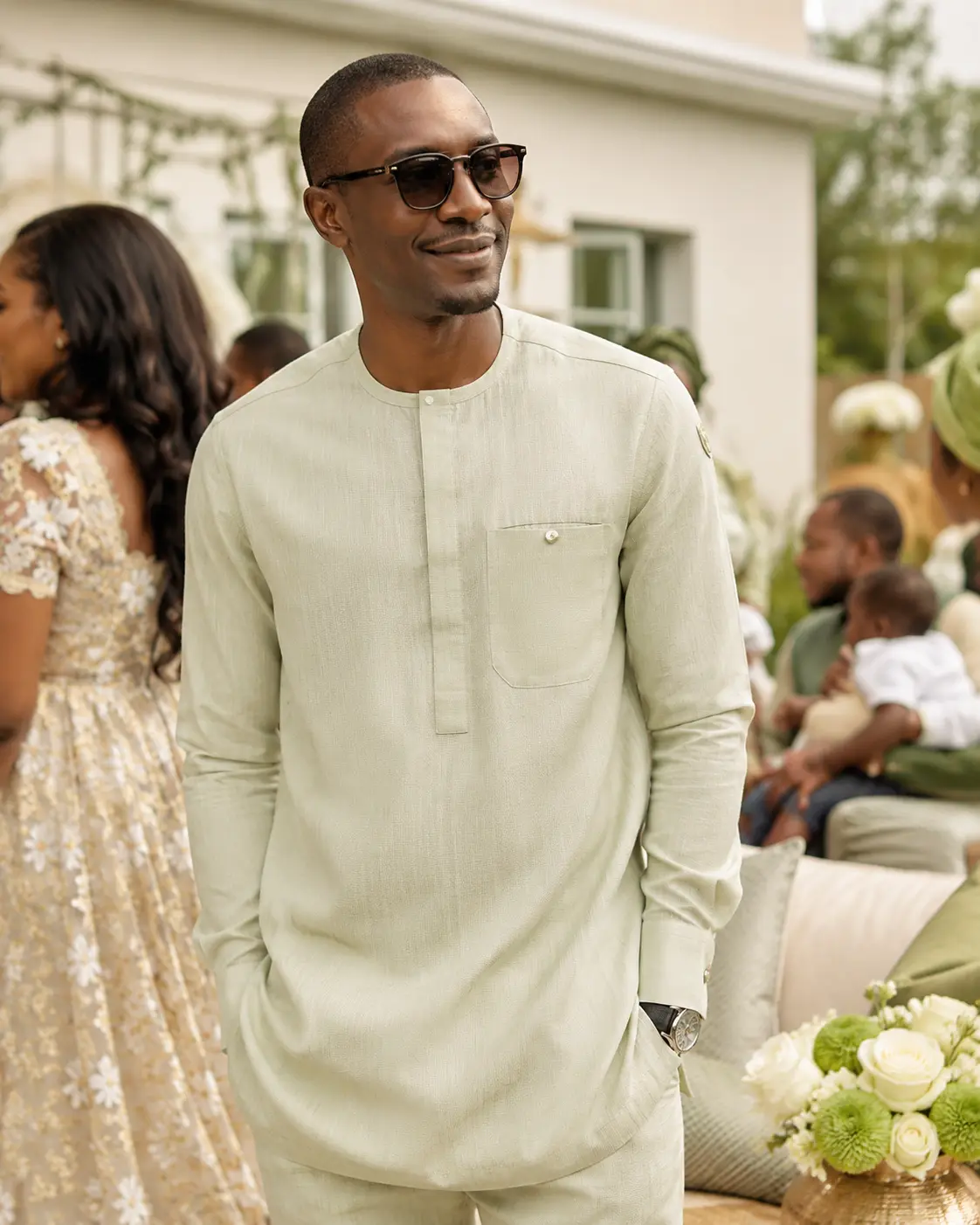
£180–£320 — the guest, correctly dressed
- Off-the-peg senator set in a matte wool-blend — oat, stone, olive or espresso.
- £40–£60 of alterations: sleeve to the wrist bone, waist suppressed, short break at the hem.
- Plain leather slip-ons and a simple cap. Nothing that needs explaining.
This is the outfit I wear to most naming ceremonies. It has never been wrong, and it does not compete with the family.
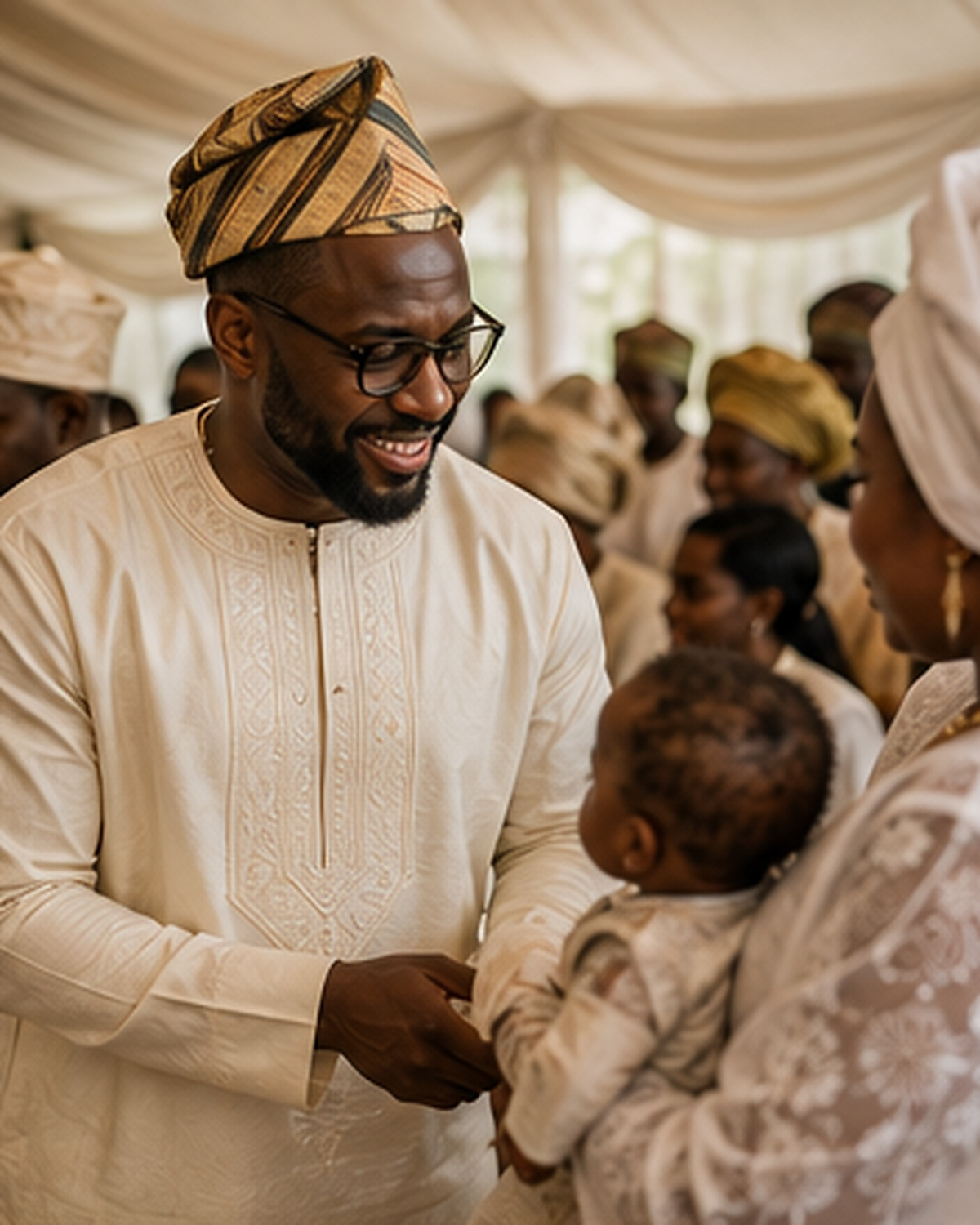
£400–£750 — the godparent or close friend
- Made-to-measure kaftan and trouser in wool-silk or a fine wool-blend, tonal embroidery only.
- One fitting at three weeks, one at ten days. Ask for a slightly longer body — you will be holding a child.
- Soft loafers, one bead bracelet, a folded pocket square you never display.
The tier that earns its money because you will wear it again — to church, to a thanksgiving, to a work dinner in Lagos.
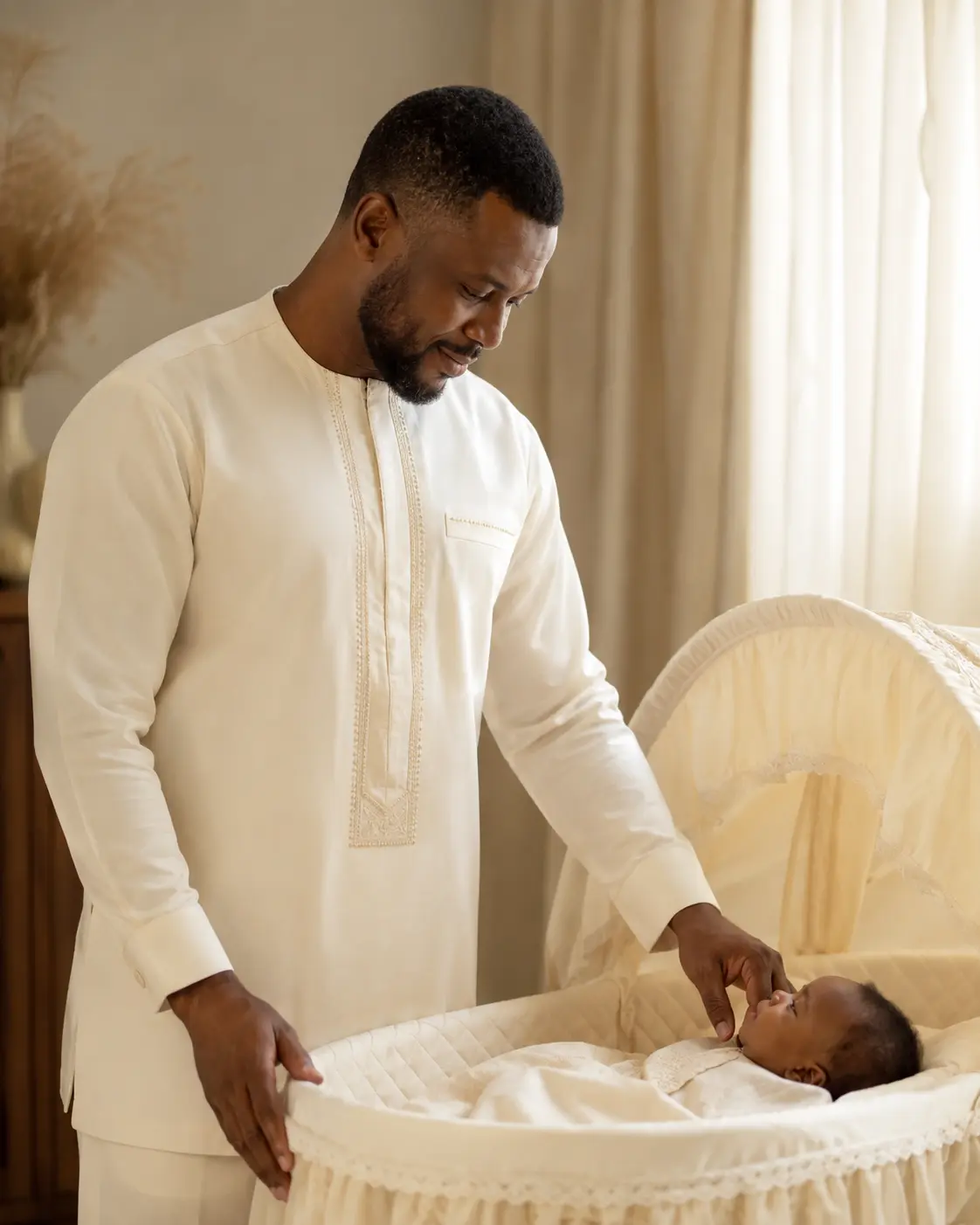
£850–£1,500 — the father
- Light agbada or ceremonial two-piece in wool-silk, cut with a real shoulder and a straight hem.
- Cloth coordinated with the mother's, not matched to it. One of you is not the backdrop.
- Fitted fila, worn-in shoes, and a plan to be carrying a baby for four hours.
Dress a notch up, then make it wearable. Every photograph from this day gets printed and kept.
08
What to change for your build
Short version below. The full set of named alterations sits in Build Filter™ and What to change for your build.
- Broad
- One tone, soft shoulder, matte cloth, waist taken in. Skip contrast trousers — they cut you across the widest point.
- Tall
- Ask for extra body and sleeve length, then break the vertical with a visible waist or a two-tone set.
- Athletic
- Buy for the chest, pay to take in the waist and sleeve. Avoid stretch blends in a warm church hall.
- Slim
- Heavier, textured cloth and a hint of shoulder structure. A waistcoat adds substance the cut will not.
- Shorter
- Matched tone, higher waist, short break, kaftan shortened rather than worn long.
- Fuller
- Structure over stretch, one colour, matte cloth, a clean single line worn a fraction longer.
09
Cap, shoes, and what to carry
The cap. A fitted fila or a plain kufi, and one you can remove during prayers without fuss. Fitted at the tailor, never bought blind.
Shoes. Broken in, and quiet. You will be on a hard hall floor for hours and possibly standing at the front of a church. A soft loafer or a clean leather slip-on; nothing new.
Jewellery. One piece. A wood or bone bracelet at most. Nothing loose near a child.
What to carry. Cash in an envelope, a card, a spare handkerchief. Somebody will hand you the baby, and both hands need to be free.
10
Six weeks, and often less
- Six weeks: ask whether there is aso ebi and a colour of the day. For a naming, six weeks is usually all the notice there is.
- Four weeks: commission anything made-to-measure. Tell the tailor the date is immovable.
- Three weeks: buy the off-the-peg pieces and book the alterations now, before the cloth arrives.
- Two weeks: fitting. Sit for five minutes in the chair, then raise both arms as if holding a child.
- One week: cap fitted, shoes worn around the house, second layer decided for the hall.
- The night before: full outfit on, photographed by a window. Morning light is what you are dressing for.
If you have three weeks or fewer, buy off the peg and spend the money on alterations. That trade is almost always the right one — the reasoning is in Ordering timelines.
11
Mistakes I have made
- 01Wore a full embroidered agbada to an eight-day naming in a front room.
- 02Chose a cloth with sheen for a ten o'clock start by a window.
- 03One heavy garment for a church service and a four-hour hall.
- 04Beads with a loose clasp, while holding a two-week-old.
- 05Trousers hemmed long, and ninety minutes seated in a pew.
- 06A cap that had to be reset every time I took it off.
- 07Arrived in the family cloth without being counted in it.
- 08New shoes on a church-hall floor, standing for the photographs.
- 09Brighter than the father, in every frame.
- 10No cash on me, at the one occasion where cash is the gift.
12
Who to contact, and what to say
Namings move quickly, so lead with the date. Tell the tailor it cannot move, ask plainly whether they can do it properly in the time, and take a no as a favour.
Include: the date and start time, whether it is church-then-hall or one venue, your role, whether there is cloth, your budget as a number, and the fit problem you always have.
What to do next
Ask whether there is cloth and a colour of the day. Then dress one level below the parents.
Tell me the occasion, the date and your budget bracket. Within 24 hours you get back: two or three houses I would actually approach and why those and not others, the alterations to insist on for your build, a realistic timeline for your date, and a short written brief you can hand to the tailor at the first fitting.
- No fee, no commission, nothing sold here.
- If nobody I trust fits your date or budget, I say so.
- Read by me, answered by me.